
Choosing the right central controller for your connected living space has never been more important. As we look ahead to 2026, the landscape of integration devices continues to evolve rapidly. This comprehensive guide helps you navigate the latest options available.
Whether you’re building your first automated residence or upgrading an existing system, understanding which central unit fits your needs can save significant time and money. We compare top-rated choices based on real-world testing and expert analysis.
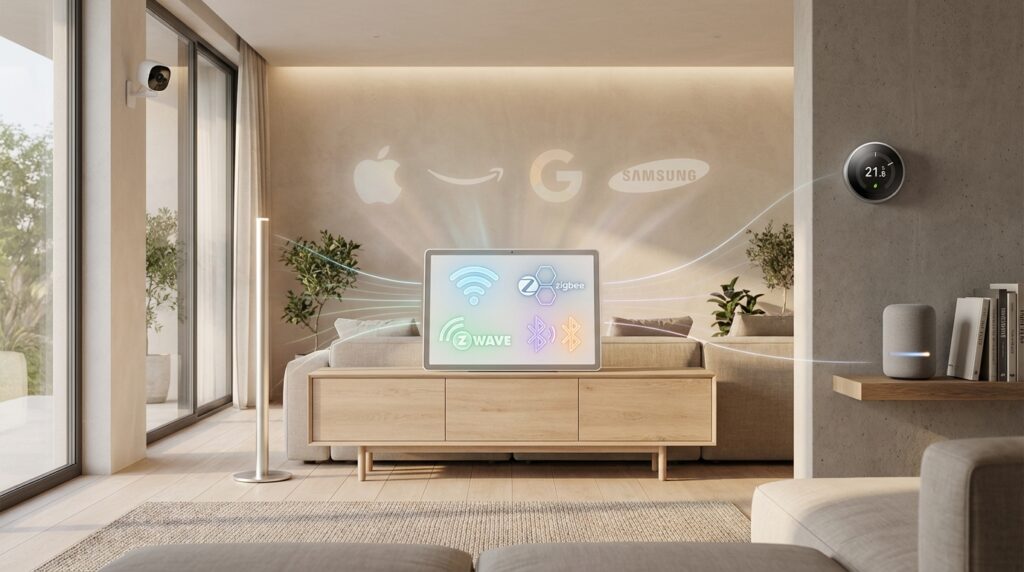
Our examination covers multi-protocol systems like Homey Pro and Aeotec alongside ecosystem-specific options from Apple, Amazon, Google, and Samsung. You’ll discover how different controllers handle everything from basic lighting to complex automation routines.
This article cuts through marketing claims to focus on what truly matters: reliability, ease of use, and device support. We provide insights drawn from hands-on testing to show how these systems perform in everyday situations.
By the end of this guide, you’ll understand which integration device delivers the best value and performance for your specific situation. We’ll help you make an informed decision that considers future-proofing and budget constraints.
Key Takeaways
- Multi-protocol hubs offer broader device compatibility than single-ecosystem options
- Local processing provides faster response times and works without internet connection
- Matter compatibility ensures future-proofing as the standard gains adoption
- Real-world performance varies significantly between different hub manufacturers
- Consider both current device support and planned future expansions
- Ecosystem lock-in can limit flexibility when adding new devices later
- Hands-on testing reveals reliability differences not apparent in specifications
Introduction
The modern connected residence faces a significant challenge: managing diverse wireless standards that don’t naturally work together. This complexity creates frustrating experiences that undermine the convenience promised by automated living.
Overview of the Smart Home Landscape
Today’s technology-filled dwellings feature an incredible variety of connected devices from different manufacturers. You might have LG televisions, Sonos audio systems, Philips lighting, and Tado climate controls all operating in the same space.
Each category excels in its specialty, but getting them to cooperate presents real difficulties. The landscape includes numerous protocols like Zigbee, Z-Wave, Thread, and Matter alongside Wi-Fi and Bluetooth.
Importance of Hubs for Modern Homes
Common frustrations like delayed responses, multiple apps, and incompatible gadgets find solutions with the right central unit. A quality controller acts as both translator and traffic director for your entire ecosystem.
Think of it as the unifying force that eliminates app-switching and creates seamless automation. Without this central piece, you miss the integrated experiences that define truly advanced living spaces in 2026.
“The right central unit transforms disconnected gadgets into a coordinated system that actually simplifies daily life.”
This foundation enables the reliable, responsive automation that makes connected living genuinely valuable rather than frustrating.
Understanding the Role of a Smart Home Hub in Modern Homes
The true power of automated living emerges when all your devices work together seamlessly. This central controller acts as the brain of your entire ecosystem, coordinating different technologies into one harmonious system.
Centralized Control Benefits
Instead of juggling multiple applications for lights, locks, and thermostats, you gain one unified interface. This single app approach eliminates the frustration of switching between different manufacturer software.
Your entire connected space becomes manageable from one convenient location. Complex routines involving various gadgets transform from technical challenges into simple, one-touch operations.
Enhancing Device Interoperability
This central unit bridges communication gaps between products using different wireless standards. It translates protocols so diverse brands can cooperate effectively.
You gain freedom to select the best individual components rather than being locked into one manufacturer’s ecosystem. A motion sensor from one company can trigger lighting from another brand effortlessly.
The hub handles all technical details behind the scenes. You enjoy smooth interactions without understanding complex wireless technologies.
Key Features and Technologies of Smart Home Hubs
Advanced controllers distinguish themselves through their processing methods and communication capabilities. These core technologies determine how reliably your automation system performs.
Local and Cloud Control
Modern integration devices typically employ a hybrid approach. They combine the speed of local processing with the convenience of remote access.
Local control keeps commands within your home network. This provides faster response times and enhanced security. Your data stays private rather than traveling through external servers.
During internet outages, locally processed automations continue functioning. Lights, locks, and sensors remain operational as long as the central unit has power. This reliability proves crucial for security and convenience.
Most quality systems balance both approaches. They offer the responsiveness of local processing while allowing remote management when you’re away.
Built-in Protocol Support
These controllers communicate with devices using various wireless standards. Built-in support for protocols like Zigbee, Z-Wave, and Thread expands compatibility.
Low-power technologies work efficiently with battery-operated devices. Locks, sensors, and plugs benefit from these energy-efficient options.
Mesh network protocols strengthen as you add more devices. Each unit acts as a signal repeater, extending coverage throughout your living space.
Ethernet connectivity provides more stable connections than Wi-Fi alone. This reduces latency for time-sensitive automations.
| Feature | Local Control | Cloud Control |
|---|---|---|
| Response Time | Instant (milliseconds) | Slower (seconds) |
| Internet Required | No | Yes |
| Data Privacy | High (local only) | Variable (external servers) |
| Remote Access | Limited | Full capability |
| Automation Reliability | High during outages | Dependent on connection |
Multi-Protocol vs. Ecosystem Hubs
Navigating the world of central controllers reveals two primary paths with vastly different implications for flexibility. Your choice between multi-protocol and ecosystem-specific units will shape your entire connected experience.
Advantages of Multi-Protocol Hubs
Multi-protocol controllers offer exceptional versatility. They support various wireless standards like Zigbee, Z-Wave, and Thread in one device.
This broad compatibility means you can mix products from different manufacturers seamlessly. You’re not limited to one company’s ecosystem when selecting thermostats, lights, or security devices.
These units connect to multiple voice assistant platforms simultaneously. You can use Amazon Alexa, Google Assistant, and Apple HomeKit without choosing just one.
Platform Lock-In Considerations
Ecosystem-specific controllers create potential limitations. They typically support fewer wireless protocols, which restricts your device options.
Platform lock-in can become costly over time. If you discover superior products that aren’t compatible, you face difficult choices.
You might need to compromise on quality or invest in a new system entirely. This flexibility concern makes future-proofing an important consideration.
Compatibility with Smart Home Devices and Protocols
The backbone of seamless device integration lies in understanding how different communication standards work together. Your controller’s protocol support determines which products will function smoothly in your setup.
Integration of Zigbee, Z-Wave, and Thread
Mesh networking technologies create self-strengthening systems. Each connected unit acts as a signal repeater, extending coverage throughout your space.
Zigbee and Z-Wave excel with battery-operated devices. They provide excellent power efficiency for sensors, locks, and lighting controls.
Thread represents the next generation of mesh networking. It offers enhanced security and seamless Matter standard integration.
High-bandwidth applications still require Wi-Fi connectivity. Cameras and streaming devices need this robust connection for video data transfer.
| Protocol | Best For | Power Usage | Network Type |
|---|---|---|---|
| Zigbee | Lights, sensors | Very low | Mesh |
| Z-Wave | Locks, plugs | Low | Mesh |
| Thread | Future devices | Low | Mesh |
| Wi-Fi | Cameras, streaming | High | Star |
Multi-protocol controllers offer the greatest flexibility. You can select devices based on quality rather than compatibility limitations.
Always verify specific manufacturer support before purchasing. This ensures all your chosen devices will work together effectively.
Impact of Matter on Smart Home Connectivity
Industry collaboration has finally delivered a universal language for smart devices. Major tech companies including Apple, Google, Amazon, and Samsung developed Matter to solve compatibility headaches.
Benefits of Unified Standards
This standard ensures your gadgets work together regardless of brand. You can mix products from different manufacturers without worrying about connectivity issues.
Local control means faster responses and better privacy. Your devices communicate directly without relying on cloud servers. This improves both security and reliability.
The system works with any platform you prefer. Whether you use Apple Home, Amazon Alexa, or Google Home, Matter-certified devices integrate seamlessly.
Preparing for Future Devices
When choosing a central controller in 2026, prioritize Matter compatibility. Look for units that function as both Matter controllers and Thread border routers.
The Matter 1.3 update expanded support to major appliances. Now your microwave, oven, and dryer can join your automated ecosystem.
Remember that Matter uses Thread and Wi-Fi—not Zigbee or Z-Wave. You’ll still need a compatible hub to integrate existing devices using those protocols.
Investing in Matter-ready infrastructure today future-proofs your setup. Manufacturers are committed to releasing Matter-certified products that work across platforms.
Real-World Performance and User Experience
Expert testing uncovers performance gaps that specifications alone cannot show. Industry veteran Jennifer Pattison Tuohy confirms this after a decade of hands-on experience: “I’ve spent 10 years living in a smart home, and I’m here to tell you that if you want yours to be fast and reliable, you need a smart home hub.”
Reliability and Local Control Performance
Users consistently report that laggy lights and delayed responses disappear with proper local processing. The system becomes noticeably more responsive when commands stay within your network.
During internet outages, the advantage becomes crystal clear. Cloud-dependent devices stop working completely while hub-based automation continues functioning normally.
Response times improve dramatically with local control. What took seconds becomes near-instantaneous when you trigger routines or flip switches.
The user experience transforms when managing everything through one well-designed app. You avoid juggling multiple applications for different manufacturers.
Advanced features become practical and reliable with a capable central unit. Complex multi-device routines work seamlessly when triggered by sensors or schedules.
Long-term satisfaction depends on quality components and software implementation. Established brands with proven track records deliver the consistent performance users expect.
The best units balance sophisticated capabilities with easy use. Everyone in your household can control basic functions without frustration while advanced options remain available.
Cost, Value, and Long-term Investment
Price points for integration devices span a wide spectrum, from entry-level solutions to premium powerhouses. Understanding this range helps you make informed financial decisions that align with your automation goals.
Budget Options Versus Premium Solutions
The Aeotec controller demonstrates excellent value at $99. It supports Z-Wave, Zigbee, Thread, Wi-Fi, and Bluetooth Low Energy. This affordable unit works with the established SmartThings platform.
Premium choices like the Homey Pro command $400 but deliver substantial processing power. You get a quad-core processor with 2GB RAM and 8GB storage. Additional protocol support includes 433MHz and Infrared capabilities.
Budget-friendly units work well for simpler setups—perhaps 20-30 devices with straightforward routines. Premium solutions excel when managing larger spaces with 50+ gadgets and complex automation scenarios.
Long-term value depends on factors beyond initial price. Consider ongoing software updates, community support, and manufacturer commitment. Ecosystem controllers from major brands often cost less upfront but can limit flexibility.
The best investment matches your current requirements while allowing room for expansion. Avoid overspending on unused features or outgrowing a basic system too quickly.
Integrating Smart Home Devices with Hubs
Seamless integration transforms individual gadgets into a cohesive ecosystem that simplifies daily routines. The right central unit bridges communication gaps between products from different manufacturers.
Streamlined Smart Home Automation
Systems like Homey Flows make automation accessible to everyone. You can create simple “if this, then that” rules that link devices with basic actions.
For example, a Fibaro button can control your Philips Hue LED strip. An IKEA motion sensor might activate a Dyson tower fan. These combinations work despite different wireless protocols.
Advanced Flows provide greater flexibility with multiple conditions and triggers. This creates sophisticated scenarios responding to complex situations.
Ease of Setup and Customization
The best options offer intuitive mobile apps with clear instructions. Automatic device discovery finds compatible products on your network quickly.
Customization should include time-based triggers and sensor conditions. This flexibility lets you design automation matching your household’s specific routines.
Visual builders with drag-and-drop interfaces make complex routines accessible. Power users can access code-level control through APIs for ultimate customization.
Local processing ensures routines execute instantly and work during internet outages. Your automation continues functioning reliably regardless of connection status.
Best Multi-Protocol Smart Home Hubs Reviewed
When it comes to unifying diverse technologies, two standout options dominate the multi-protocol landscape. These powerful units bridge communication gaps between products using different wireless standards.
They offer exceptional flexibility for mixing brands and protocols. This approach eliminates ecosystem lock-in while maximizing device compatibility.
Detailed Comparison of Homey Pro and Aeotec Hub
The Homey Pro represents the premium choice with comprehensive protocol support. It handles Zigbee, Z-Wave, 433MHz, Infrared, Thread, Wi-Fi, and Bluetooth Low Energy.
This unit functions as both a Matter controller and Thread border router. It connects seamlessly to Amazon Alexa, Google Home, and Apple Home ecosystems simultaneously.
Homey’s integration library covers over 50,000 devices from major brands. The mobile app balances beginner-friendly design with advanced customization options.
The Aeotec Smart Home Hub delivers outstanding value at $99. It supports Z-Wave, Zigbee, Thread, Wi-Fi, and Bluetooth through the established SmartThings platform.
SmartThings Edge architecture enables strong local control for faster responses. The automation engine excels at creating complex routines with multiple conditions.
While Homey Pro offers superior processing power and more protocols, Aeotec provides excellent performance within the SmartThings ecosystem. Your choice depends on budget and specific needs.
Platform/Ecosystem Hubs: Apple, Alexa, Google, and More
Apple, Amazon, Google, and Samsung each provide unique gateway devices that serve as the centerpiece of their respective automation platforms. These specialized units deliver seamless integration within their native environments.
Unique Benefits of Each Ecosystem
The Apple TV 4K stands out with Thread and Bluetooth 5.0 radios. It includes Wi-Fi 6 and gigabit ethernet for reliable performance. This makes it ideal for Apple Home enthusiasts.
Amazon’s Echo Hub brings Zigbee, Thread, and Matter support to Alexa users. It’s the first Echo device with power over ethernet capability. This ensures maximum reliability for your connected space.
Google Nest Hub (second-gen) supports Thread and Matter alongside Wi-Fi. It doubles as a control panel and entertainment device. The built-in screen provides visual feedback for your automation.
SmartThings Station offers an affordable entry into the Samsung ecosystem. It supports Zigbee and Thread but excludes Z-Wave. This makes it perfect for users who don’t need that specific protocol.
| Platform | Key Device | Protocol Support | Unique Advantage |
|---|---|---|---|
| Apple | TV 4K | Thread, Bluetooth 5.0 | Privacy and security focus |
| Amazon | Echo Hub | Zigbee, Thread, Matter | Widest voice control options |
| Nest Hub | Thread, Matter, Wi-Fi | Google services integration | |
| Samsung | SmartThings Station | Zigbee, Thread | Powerful automation engine |
Local Control in Ecosystem Hubs
Local capabilities are improving across all platforms. Thread and Matter enable devices to communicate directly on your network. This reduces dependence on manufacturer cloud servers.
Each ecosystem offers distinct advantages for different user preferences. Platform-specific hubs often cost less initially. They integrate into devices you might purchase anyway.
Remember that your ecosystem choice locks you into that platform’s compatibility. Consider this when building your connected living space for the long term.
Selecting the Best smart home hub for Your Needs
Your journey to an integrated home begins with understanding your unique automation requirements. The right choice depends on several personal factors that vary from household to household.
Factors to Consider
Start by honestly evaluating your current device count and technical comfort level. Are you managing a simple setup or planning extensive expansion?
Protocol requirements matter significantly if you own existing equipment. Zigbee lights or Z-Wave locks need compatible support to avoid replacement costs.
Beginners often find ecosystem controllers more approachable. Tech-savvy users can leverage advanced platforms like Homey Pro for greater customization.
Matching Features with Home Requirements
Think about specific use cases for your living space. Do you need sophisticated security integration or energy monitoring capabilities?
Local control and Matter support should be considered essential in 2026. Ethernet connectivity ensures reliable performance for time-sensitive automations.
Budget considerations extend beyond the initial purchase. Factor in compatible devices and potential installation costs.
Future-proof your investment by choosing units with active development and strong community support. This ensures compatibility with emerging standards.
Future Trends in Smart Home Automation
The evolution of automated living spaces is accelerating, bringing exciting new capabilities to homeowners. These advancements focus on making systems more intuitive and interconnected than ever before.
Regular updates to the Matter standard ensure your investment remains current. The Connected Standards Alliance refines this protocol every six months.
Emerging Technologies and Protocols
Machine learning represents a significant leap forward for automated systems. Your central unit can learn patterns and optimize routines automatically.
This creates genuinely intelligent environments that adapt to your lifestyle. You spend less time programming and more time enjoying the benefits.
Thread network infrastructure is stabilizing as the preferred mesh protocol. It efficiently handles low-power devices like sensors and motion detectors.
Energy management systems are becoming remarkably sophisticated. They provide real-time usage data and automated optimization suggestions.
Voice control technology now understands context and complex requests. Conversational AI remembers preferences across different device types.
Privacy concerns are driving more processing to local units. This edge computing approach keeps sensitive data within your home network.
We see convergence with security, EV charging, and solar power management. These integrated systems create comprehensive home management solutions.
Conclusion
Your final decision on an automation controller will shape how effortlessly your gadgets work together. The best smart choice balances your current setup with future expansion plans.
Whether you prefer multi-protocol units like Homey Pro or ecosystem-specific options from Alexa or Google, prioritize Matter compatibility. This ensures your investment remains relevant as new devices emerge.
A quality central unit transforms frustrating experiences into seamless operation. Your sensor triggers and lights respond instantly, working together through reliable automation.
Local processing keeps commands on your home network, providing faster responses and better security. This approach ensures your system functions during internet outages.
The right controller offers flexibility to choose top products from different manufacturers. You avoid being locked into one company’s ecosystem while enjoying powerful automation possibilities.
As technology evolves, your well-chosen foundation will adapt to emerging standards and new device categories.