
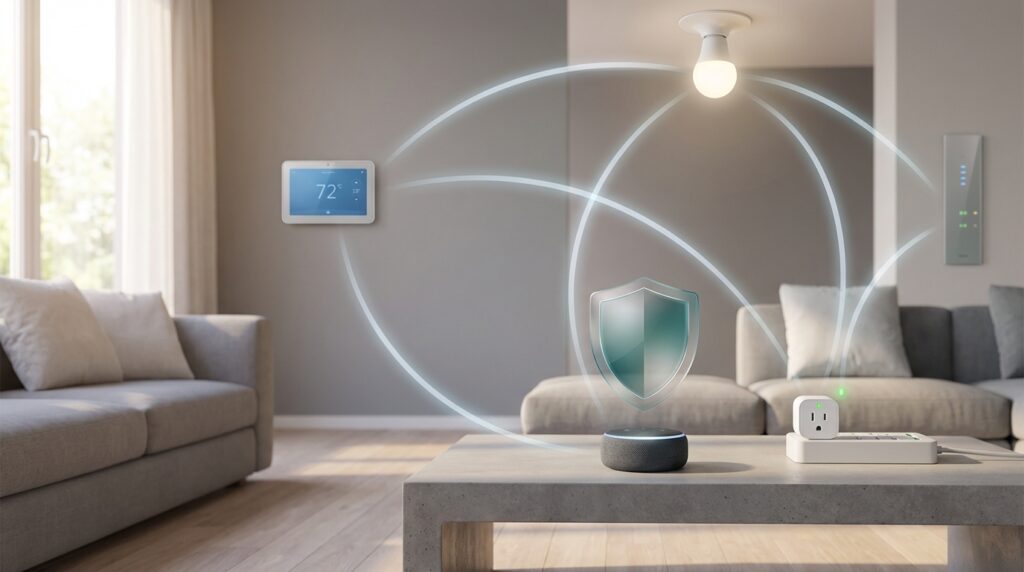
Buying smart home gadgets can feel confusing. You wonder if a new light bulb will work with your speaker or if a smart plug will connect to your phone. A new standard is here to fix that.
This guide explains the official program that ensures your devices play nicely together. We will show you how this process works and why it benefits you directly.
When a product earns this badge, it has passed strict tests. These tests check for security, reliability, and the ability to work with other brands. This gives you confidence in your purchase.
We break down the technical details into simple terms. You will learn about the testing groups and the steps manufacturers take. Our goal is to help you shop with clarity.
By the end, you will see the logo on a box as a promise. It is a sign of quality and seamless compatibility for your home.
Key Takeaways
- This standard guarantees that different brands of smart home products will work together seamlessly.
- Products with the official logo have been tested for security and reliability.
- Understanding this process helps you make smarter and more confident purchasing decisions.
- The logo on a product’s packaging is a clear sign of proven interoperability.
- This initiative simplifies the smart home experience and protects your investment.
Introduction to Matter Certification and Its Importance
Imagine being able to mix and match smart home products without worrying about whether they’ll work together. This vision is becoming reality thanks to industry-wide collaboration.
The smart home market has evolved from isolated ecosystems to interconnected networks. A unified approach now simplifies the consumer experience.
Defining Matter in the IoT Ecosystem
Matter represents a groundbreaking open-source protocol developed by the Connectivity Standards Alliance. This organization brings together hundreds of technology companies.
The standards alliance created this universal language for smart home devices. It ensures different brands can communicate seamlessly across platforms.
This development addresses the fragmentation that previously limited consumer choices. The protocol establishes common ground for interoperability.
Key Benefits for Buyers
Consumers gain significant advantages from this standardized approach. You can now build a smart home with confidence.
Key benefits include:
- Simplified setup processes across different device types
- Enhanced security features built into the standard
- Future-proof investments that maintain compatibility
- Freedom to choose products based on preference rather than ecosystem limitations
The Connectivity Standards Alliance continues to drive innovation while ensuring reliability. This commitment to open standards benefits everyone in the smart home space.
Deep Dive into Matter Certification Process
Behind every trusted smart home product lies a thorough examination process that validates performance and compatibility. This mandatory procedure ensures devices meet strict standards before joining your home network.
The system protects consumers by preventing uncertified items from connecting. This security measure maintains network integrity across all compatible products.
Step-by-Step Certification Overview
Manufacturers begin by submitting their devices for evaluation. The initial phase involves Device Attestation, where products must prove their certified status cryptographically.
This security feature occurs during the commissioning process. Each device demonstrates it has passed the necessary checks before gaining network access.
The official certification program requires detailed documentation from manufacturers. They must provide Protocol Implementation Conformance Statements and security attestations.
Understanding Testing and Approval
Authorized testing laboratories conduct rigorous evaluations of both hardware and software components. They verify that devices meet all specification requirements outlined in the standard documentation.
Testing covers interoperability, security protocols, and reliability in real-home environments. Products undergo comprehensive validation across multiple criteria.
Only after successful completion can devices display the official logo. This mark indicates full compliance with all security mechanisms and functionality requirements.
Membership and Vendor ID: Joining the Connectivity Standards Alliance
The pathway to product approval begins with formal enrollment in the industry consortium that oversees compatibility standards. Manufacturers must join the Connectivity Standards Alliance before their devices can undergo validation.
This membership requirement ensures all participants contribute to maintaining the ecosystem’s integrity. The alliance structures its enrollment to accommodate companies of various sizes and commitment levels.
Enrollment Tiers and Membership Benefits
Four distinct membership tiers offer different levels of involvement and influence. The Adopter level represents the minimum requirement for product validation at $7,000 annually.
Higher tiers like Participant ($20,000/year) and Promoter ($105,000/year plus one-time payment) provide greater specification input. Each level offers increasing benefits, from workshop participation to board seats.
The Certification Transfer Program provides an Associate option for rebranding existing certified products. This path has no annual fee but charges $2,500 per product plus $500 yearly maintenance.
Understanding these costs helps appreciate the investment manufacturers make. You can learn more about how the certification process works in detail.
Obtaining a Vendor ID and Unique Product Codes
New members immediately receive a Vendor ID that identifies their company within the system. This unique identifier traces every product back to its origin.
Each validated device gets a 16-digit Product ID code that functions like a passport number. This system enables clear traceability and accountability throughout the device lifecycle.
These identification mechanisms benefit you as the end user. They ensure authentic certified products through the Distributed Compliance Ledger.
Network Transport Layers and Pre-Testing Strategies
Manufacturers face important decisions about connectivity options before testing begins. The right network choice impacts both device performance and your smart home experience.
This planning phase determines how well products will integrate into your existing setup. Smart selection leads to smoother operation and better compatibility.
Choosing the Right Connectivity (Wi-Fi, Thread, Ethernet)
The standard offers three main transport options for device communication. Each serves different purposes in your home network.
Ethernet provides reliable wired connections for stationary devices like hubs. Wi-Fi handles high-bandwidth needs for cameras and displays. Thread creates efficient mesh networks for battery-powered sensors.
Products without screens often include Bluetooth Low Energy for easy setup. This lets your smartphone guide the commissioning process. Manufacturers must secure Bluetooth SIG approval for these features.
Using pre-certified modules from companies like Infineon or Silicon Labs can simplify this step. This approach reduces testing requirements and development costs.
Utilizing the Matter Test Harness for Pre-Testing
The Matter Test Harness represents a valuable tool for early validation. This comprehensive software helps manufacturers verify protocol implementation.
Pre-testing catches issues before formal laboratory evaluation. It ensures devices meet the required specification for interoperability.
This strategy saves significant time and money. Problems discovered during authorized testing can lead to expensive retests. Early detection means faster fixes and better product quality.
For you as a buyer, this thorough preparation translates to more reliable devices. It means products work correctly right out of the box.
Authorized Testing and Compliance Verification
The final stamp of approval on any interoperable device comes from specialized facilities that put products through their paces. These independent centers ensure every smart home gadget meets strict standards before reaching your home.
Role of Authorized Test Laboratories (ATLs)
Authorized test laboratories serve as the gatekeepers of product quality. The Connectivity Standards Alliance contracts these independent institutes to conduct rigorous evaluation.
Nine major authorized test providers operate globally with synchronized testing systems. This ensures consistent results regardless of location.
| Test Provider | Location | Region |
|---|---|---|
| UL Solutions | United States | North America |
| GRL Granite River Labs | United States | North America |
| Element Materials Technology | United Kingdom | Europe |
| DEKRA | Germany | Europe |
| TÜV Rheinland | Germany | Europe |
| Bureau Veritas | France | Europe |
| Resillion | Belgium | Europe |
| Allion Labs | Taiwan | Asia |
| Cesi China Electronics Standardization Institute | China | Asia |
Specification Validation Events and Test Reports
Specification Validation Events offer an alternative testing path. The Matter working group organizes these irregular meetings for collaborative evaluation.
“Independent verification ensures that products work seamlessly together from day one.”
Successful completion at these events provides confirmation equivalent to laboratory testing. The test report generated serves as critical compliance documentation.
After approval, manufacturers receive a digital Certification Declaration file. This enables verification through the Distributed Compliance Ledger.
The ledger uses blockchain technology for security. It creates a tamper-proof registry where devices prove authenticity.
This system protects buyers by blocking non-compliant products. Only genuinely tested devices can join your network.
Exploring Certification Options: CTP, Similarity, and Product Family
Manufacturers have several pathways to validate their smart home devices for interoperability. These different approaches help companies bring compatible products to market efficiently.
The right path depends on whether the hardware is entirely new or builds upon existing designs. Each option maintains the same high standards for security and performance.
Certification by Testing a Single Product
This is the standard route for brand-new device types. The hardware undergoes complete evaluation at an authorized laboratory.
This thorough testing ensures every aspect meets the required specifications. It establishes a baseline that can benefit future related items.
Advantages of Certification by Similarity and Family Certification
Product Family validation offers significant efficiency. Only the “parent” device requires full testing.
Family members with minor differences gain approval without redundant checks. This saves time and resources while maintaining quality.
Certification by Similarity provides another streamlined path. Products nearly identical to already-approved items can skip additional testing.
The Certification Transfer Program enables companies to rebrand existing compliant products. This requires partnership with the original manufacturer.
These flexible options mean you’ll see more diverse interoperable devices. The recent update added support for energy management hardware and home routers.
Understanding “matter certification” and Its Market Impact
The marketplace for smart home technology is undergoing a significant transformation as interoperability becomes the new benchmark. This shift creates a more competitive environment where quality and performance take priority over proprietary ecosystems.
How Certification Influences Product Reliability
Every device bearing the official logo has passed rigorous testing for consistent performance. This validation process ensures products communicate reliably across different brands and network conditions.
The testing regime establishes a quality floor that protects consumers from substandard devices. Products must demonstrate secure connections and stable operation in various home environments.
Boosting Consumer Trust and Adoption
The recognizable insignia provides immediate assurance during the purchasing process. Consumers can confidently select items knowing they’ll integrate seamlessly with existing setups.
Industry experts project substantial growth in compatible devices over the next five years. This represents a fundamental shift toward open standards that benefit end users.
When you research products on the CSA website, you access verified information about tested devices. This public database serves as your trusted resource for validating compatibility claims. Understanding how the Matter protocol works helps you make informed decisions about your smart home investments.
Conclusion
Building a reliable smart home ecosystem now has a clear roadmap. The Connectivity Standards Alliance has created a system that guarantees compatibility across brands.
This guide has shown how rigorous testing protects your investment. Products with the official logo have proven their security and performance.
The multiple approval paths ensure quality while encouraging innovation. You can shop with confidence knowing certified devices will work together seamlessly.
Always look for the logo when buying smart home products. Verify current listings on the official Connectivity Standards Alliance website for the latest information.
Your understanding of this process empowers smarter choices. You can now create a home that grows with your needs over time.