
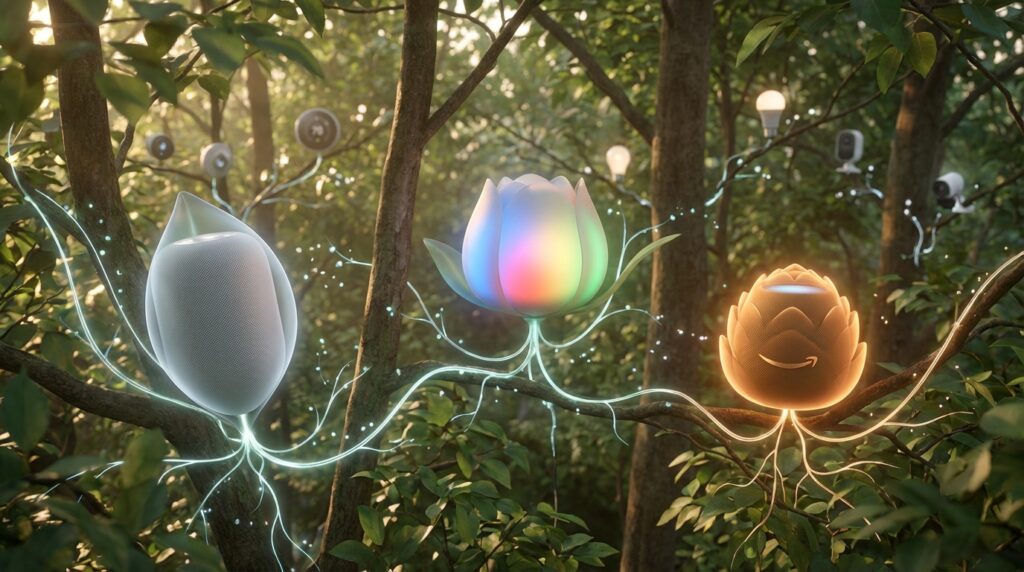
Have you ever wondered how your smart home devices from different brands can work together seamlessly? The answer lies in a fascinating connection between nature’s design and modern technology. Just like plants and animals in a forest depend on each other, your smart devices now communicate through a shared language called Matter.
This guide explores how the same principles that govern natural environments apply to your smart home. You’ll discover surprising parallels between biological processes and the way devices from Apple, Google, and Amazon interact. The flow of information between gadgets mirrors how energy moves through living systems.
We’ll break down complex concepts into simple, relatable terms. Understanding these connections helps you appreciate why interoperability matters so much in today’s smart homes. When devices can “talk” to each other effectively, your entire setup becomes more efficient and user-friendly.
The Matter standard represents more than just technical specifications—it embodies the same principles of interconnectedness that sustain life itself. By the end of this article, you’ll see your smart home in a whole new light, appreciating the elegant design behind the technology you use every day.
Key Takeaways
- Matter creates a universal language for smart home devices from different manufacturers
- Natural ecosystems and smart home technology share similar communication principles
- Apple HomeKit, Google Home, and Amazon Alexa platforms now support Matter compatibility
- Interoperability allows devices to work together like organisms in a balanced environment
- The flow of information between devices mirrors energy transfer in natural systems
- Understanding these connections makes smart home setup and management easier
- Matter represents a significant step toward truly integrated smart home experiences
Exploring Matter Ecosystems
Nature’s intricate dance of resource exchange offers surprising insights into modern smart home technology. Living creatures constantly share materials and power in beautifully efficient ways.
The Role of Matter and Energy Transfer
In natural systems, matter energy transfer keeps everything running smoothly. Plants convert sunlight into food through photosynthesis. Animals then consume plants or other animals.
This process breaks down complex molecules from organisms into usable energy. The transfer of resources enables growth and sustains life functions. Every living thing participates in this cycle.
Why Matter Ecosystems Matter in Technology
Smart home devices operate on similar principles. The Matter protocol creates a universal language for devices. Data flows between gadgets like energy moves through living systems.
This interconnected approach prevents communication breakdowns. Your smart thermostat shares temperature data with lights and speakers. The entire system works harmoniously, much like a healthy biological community.
| System Component | Natural World | Smart Home Technology |
|---|---|---|
| Energy Source | Sunlight, food | Electricity, data |
| Transfer Method | Consumption, photosynthesis | Wireless communication |
| Key Participants | Plants, animals, microbes | Lights, thermostats, speakers |
| Result | Sustained life functions | Seamless automation |
Smart Home Platforms: Integration Across Apple, Google, and Amazon
What if you could mix and match smart devices from different brands without worrying about compatibility issues? For years, Apple HomeKit, Google Home, and Amazon Alexa operated as separate systems. Each platform created its own walled garden, forcing users to choose sides.
The new connectivity standard changes everything. It acts as a universal translator between previously isolated platforms. This breakthrough eliminates the fragmentation that wasted both your time and electrical energy.
Now, a single Matter-certified device works across all three major platforms simultaneously. Your smart bulb connects to Apple, Google, and Amazon services without needing multiple hubs. This streamlined approach reduces the energy required to manage your connected home.
The unified system enables smooth interactions between devices from different manufacturers. A motion sensor can trigger automations across all your platforms with one setup. Information transfer becomes faster and more reliable.
This technological approach mirrors natural wisdom about interconnected ecosystems. Just as biodiversity strengthens environments, platform diversity now benefits users. Your smart home investment stays relevant regardless of which phone or assistant you prefer.
Understanding Natural Cycles and Energy Flow in Ecosystems
Earth’s natural systems operate through elegant cycles that redistribute vital resources across the planet. These continuous processes demonstrate how elements move between living organisms and their environment.
The Water Cycle: From Evaporation to Precipitation
The water cycle begins when the sun’s energy transforms liquid water into vapor through evaporation. Plants also contribute through transpiration, releasing moisture from their leaves.
This vapor rises and cools, forming clouds through condensation. When droplets become heavy enough, they fall as precipitation—rain, snow, or hail. Much of this water infiltrates the ground, replenishing underground reserves.
Oceans hold about 97% of Earth’s water, while only 0.003% of fresh water is readily available for human use. This makes the continuous cycling of water essential for life.
Carbon and Nitrogen Cycles: Balancing Organic and Inorganic Processes
Carbon dioxide from the air combines with water during photosynthesis. Plants convert this into organic matter that flows through food webs.
Respiration returns carbon dioxide to the atmosphere, completing the cycle. Nitrogen follows a similar path but requires special bacteria to convert atmospheric gas into forms plants can use.
Phosphorous Cycle: Nutrient Flow and Environmental Impact
Phosphorus moves slowly from rocks into soil through weathering. Plants absorb these nutrients through their roots.
The element travels through food chains until decomposition returns it to the soil. Some phosphorus washes into oceans, eventually forming new sedimentary rocks over millions of years.
| Natural Cycle | Key Process | Primary Elements | Time Scale |
|---|---|---|---|
| Water Cycle | Evaporation & Precipitation | H₂O | Days to Weeks |
| Carbon Cycle | Photosynthesis & Respiration | CO₂, Organic Carbon | Hours to Centuries |
| Nitrogen Cycle | Nitrogen Fixation | N₂, Ammonia, Nitrates | Days to Years |
| Phosphorus Cycle | Weathering & Absorption | Phosphates | Years to Millennia |
These interconnected processes demonstrate fundamental principles of energy and matter cycles that maintain environmental balance. Each cycle depends on specific conditions including air composition and soil chemistry.
Bridging Natural Ecosystems and Technological Innovation
The ocean’s remarkable ability to sustain life offers powerful lessons for creating interconnected smart home technologies. Marine environments demonstrate how tiny components can create massive impacts throughout entire systems.
Insights from Ocean Literacy and Terrestrial Systems
Ocean microbes form the foundation of all marine food webs. These microscopic organisms produce most of Earth’s oxygen through their incredibly fast life cycles.
The biosphere shows us that different environments foster unique interactions. Ocean life exhibits relationships like symbiosis that don’t occur on land. This diversity teaches us valuable ways to approach technological challenges.
Applying Natural Processes to Smart Home Solutions
Smart home devices can learn from how living organisms adapt to their environment. Just as marine life responds to changing conditions, your technology can automatically adjust to your preferences.
The principle of multiple pathways ensures system reliability. If one device fails, others can compensate—much like how natural systems maintain balance. This approach creates more resilient smart home environments.
By studying how organisms solve problems in various environments, we develop flexible solutions. Your smart home can work across different layouts and lifestyle preferences, enhancing your daily life through intelligent design.
Practical Examples of Matter and Energy in Everyday Life
Every time you compost kitchen scraps, you’re participating in nature’s recycling program. This simple act demonstrates how living systems transform waste into valuable resources. Your compost bin becomes a miniature version of natural processes that sustain our planet.
Food Chains, Decomposers, and Producers in Action
Decomposers like earthworms and mushrooms break down dead plants and animal materials. They release energy while creating nutrient-rich soil. This natural recycling shows how nothing in healthy ecosystems truly goes to waste.
Your houseplants provide a perfect example of photosynthesis in action. They use solar energy to convert carbon dioxide into food while producing oxygen. This process forms the foundation of all food webs.
Animals function as consumers in these interconnected systems. Herbivores eat plants directly, while carnivores eat other animals. Each organism extracts what it needs for growth and daily activities.
Consider a simple garden example: grass grows through photosynthesis, insects eat the grass, and birds eat the insects. This chain shows how energy flows from producers to consumers. The cycle continues as waste materials return to decomposers.
These natural cycles teach us about efficient matter and energy transfer. Understanding how living organisms maintain balance helps us create smarter technological solutions.
Enhancing Your Living Environment with Smart, Sustainable Solutions
Creating a smarter home environment goes hand-in-hand with making more sustainable choices. Smart technology helps you manage your resources wisely. It turns your living space into an efficient, responsive system.
Think of your home’s energy use like a forest’s health. Biodiversity keeps a forest thriving. Similarly, a diverse set of smart devices working together creates a stronger, more resilient home environment.
Deforestation harms these natural systems. Reforestation helps them heal. Upgrading to efficient smart tech is like digital reforestation for your home.
These devices perform key functions to save energy. Smart thermostats learn your schedule. Lights turn off automatically in empty rooms. These small interactions add up to big savings.
You gain precise control over your home’s energy life. This reduces waste and your carbon footprint. It’s a practical step toward a healthier planet.
| Sustainable Action | Natural Benefit | Smart Home Benefit |
|---|---|---|
| Planting Trees | Restores habitats, cleans air | Smart devices reduce energy demand, lowering emissions |
| Water Conservation | Protects freshwater reserves | Smart irrigation uses weather data to water lawns efficiently |
| Reducing Waste | Minimizes landfill impact | Smart schedules optimize appliance use, preventing waste |
| Monitoring Health | Ensures ecosystem balance | Smart sensors monitor air quality and energy use in real-time |
The right technology makes your home environment more comfortable and efficient. It supports all your daily functions while protecting our shared world.
Conclusion
Nature’s time-tested strategies for resource sharing have found their perfect technological counterpart. The same principles that allow diverse organisms to thrive together now power your smart home’s seamless operation.
This interconnected approach creates a more efficient living system. Your devices work together like a healthy biological community, conserving energy while enhancing daily life.
The future of home technology embraces these natural patterns. As you build your smart home, remember that cooperation and efficient resource transfer create the most resilient systems.