
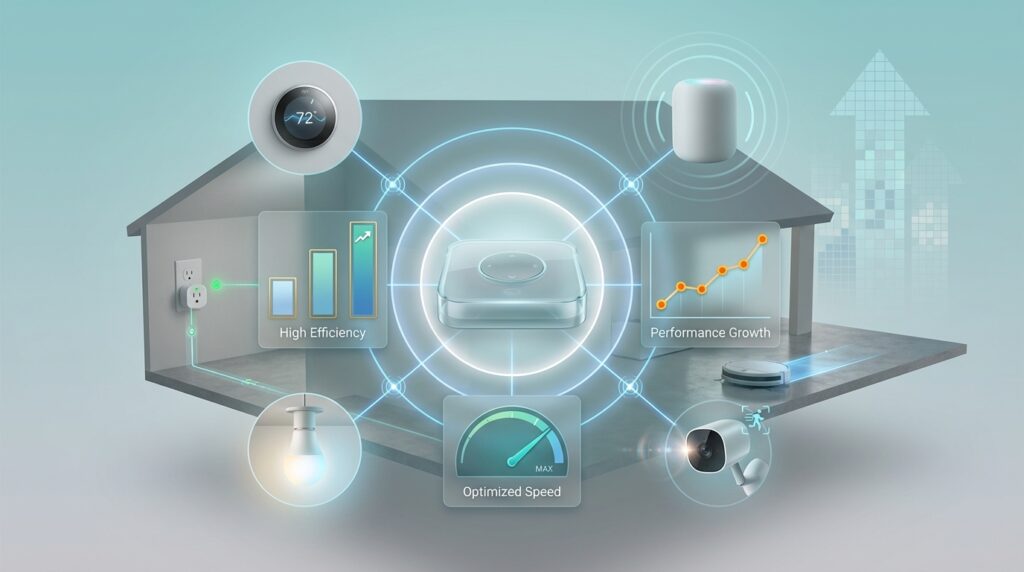
Welcome to our friendly guide on evaluating automated living systems. The industry is growing at an incredible pace, making it essential to understand how different products compare.
Recent data shows this sector’s remarkable expansion. The global market was valued at around $147 billion in 2025. Experts project it could reach over $848 billion by 2034. This represents a growth rate of more than 21% each year.
With so many options available, knowing what makes a system stand out is crucial. Consumers want reliable, efficient technology that improves daily life. Our analysis helps you identify the best choices for your needs.
We’ll explore what truly matters in today’s connected living spaces. From energy savings to seamless integration, we break down the factors that define quality. This information empowers you to make informed decisions.
Key Takeaways
- The automated living sector is experiencing rapid global growth with significant market expansion projected
- Understanding system comparisons helps consumers identify high-quality, reliable products
- Energy efficiency and seamless integration are key factors in modern connected living spaces
- Market trends show increasing consumer demand for practical, accessible automation solutions
- Technical aspects like connectivity reliability and security features greatly impact user satisfaction
- Proper evaluation separates exceptional products from average offerings in this competitive market
- Data-driven insights help navigate the evolving landscape of connected living technologies
Industry Report Overview
Dive into our thorough market assessment that maps the evolving world of integrated household systems. This analysis delivers crucial insights for understanding today’s automated living landscape.
Purpose and Key Objectives
Our report aims to give you a complete picture of the current smart home market environment. We examine how different products measure up across various regions and platforms.
Key goals include tracking market size changes and identifying leading innovators. We also explore how technologies adapt to consumer needs for convenience and security.
Scope and Methodology
This research covers the global smart home sector with special focus on North America. It breaks down segments by installation type, connectivity protocols, and device categories.
We used rigorous methods combining multiple data sources. Our team analyzed trends from 2021 through 2034, providing accurate projections based on a 21.40% growth rate.
The approach includes both number-based analysis of market growth and quality-based assessment of consumer preferences. This helps you compare products against industry standards effectively.
Understanding Smart Home Performance Benchmarks
Discover the essential metrics that define quality in modern residential technology. These automated spaces feature devices you can control from anywhere using your phone or computer.
True intelligence in these systems comes from their ability to manage lighting, climate, and security seamlessly. The real value lies in how well they deliver convenience and efficiency.
When evaluating these technologies, we measure several critical factors. Response time tells us how quickly devices react to commands. Reliability indicates consistent operation without failures.
Integration capabilities show how well different products work together. A truly advanced system adapts to your household’s unique patterns and preferences.
Key indicators include connection stability and energy savings. Strong security features protect against digital threats while ensuring authorized access.
Modern innovations like artificial intelligence raise expectations significantly. The best solutions now offer predictive adjustments and voice command accuracy.
Understanding these standards helps you distinguish basic alert systems from truly intelligent protection. Industry-wide measurement criteria make product comparison straightforward.
This knowledge empowers you to choose solutions that genuinely enhance daily living while delivering measurable benefits.
Global Smart Home Market Trends
Current market analysis reveals fascinating patterns in how residential technology adoption varies globally. The automated living sector shows distinct growth trajectories across different continents.
Growth Projections and Market Size
The global automated living sector demonstrates phenomenal expansion. Market size reached $147.52 billion in 2025 and could hit $848.47 billion by 2034.
This represents a 21.40% compound annual growth rate. Consumer demand for convenience and security drives this remarkable expansion.
Regional Variations and Dynamics
North America currently leads with 31.70% market share. High disposable income and tech awareness fuel this dominance.
Asia Pacific shows the fastest projected growth rate. Rapid urbanization and government initiatives support this acceleration.
Europe’s growth stems from sustainability concerns. The Middle East and Africa see increasing demand in luxury developments.
| Region | Market Share (2025) | Growth Rate | Key Drivers |
|---|---|---|---|
| North America | 31.70% | Steady | High income, tech adoption |
| Asia Pacific | Growing | Fastest | Urbanization, middle class |
| Europe | Significant | Strong | Sustainability regulations |
| Middle East/Africa | Emerging | Increasing | Luxury developments |
These trends indicate a shift from niche to mainstream adoption. Automated living technology becomes increasingly accessible worldwide.
Technical Advancements in Smart Home Technology
Cutting-edge developments are transforming automated household systems into more intuitive companions. These innovations create more responsive living environments that adapt to daily routines.
Integration of IoT and Connectivity Solutions
Modern connectivity protocols enable seamless communication between household devices. Wi-Fi 6, Zigbee, and Z-Wave provide stable connections for multiple gadgets.
These technologies ensure instant responses to commands. They maintain reliability even with dozens of active devices.
Role of Generative AI and Advanced Analytics
Generative artificial intelligence is becoming increasingly important in residential automation. Recent data shows significant adoption rates among consumers.
According to a 2024 survey, nearly 40% of U.S. adults aged 18-64 used generative AI. Remarkably, usage was higher in residential settings than workplace environments.
| Usage Context | Percentage of Users | Frequency |
|---|---|---|
| Residential AI Usage | 32.6% | Daily or weekly |
| Workplace AI Usage | 28.1% | Regular basis |
| Overall AI Adoption | 39.8% | Various frequencies |
This technology enables natural conversations with automated assistants. Systems can provide contextual responses rather than simple commands.
Advanced analytics learn from behavior patterns to anticipate needs. They adjust settings based on time, occupancy, and external factors.
Market Segmentation and Performance Metrics
Market segmentation provides crucial insights into how different technologies perform across various categories. This analysis helps identify which segments drive growth and deliver the best value.
Segmentation by Application and Protocol
The retrofit segment captured the largest market share in 2024. Homeowners prefer upgrading existing properties with energy-efficient devices rather than waiting for new construction.
Wireless protocols dominate the automated living landscape. They offer easier installation without extensive rewiring requirements. This makes adoption more accessible for various applications.
New construction shows the highest projected growth rate. Builders increasingly include automated systems as standard features. Tech-savvy buyers now expect these capabilities in modern residences.
Analysis by Device Type and Energy Efficiency
Entertainment devices held the largest market share by device type in 2024. Consumers prioritize home entertainment upgrades for daily enjoyment.
Security and access control systems demonstrate the fastest growth rate. Integrated solutions combine cameras, smart locks, and motion sensors. These provide comprehensive protection that outperforms traditional systems.
Energy management shows impressive metrics. Automated thermostats and lighting can reduce consumption by 15-30%. This translates to significant cost savings within one to two years.
Regional Performance in North America and Beyond
Regional analysis uncovers fascinating differences in how automated systems gain traction across global markets. Each continent shows unique adoption patterns influenced by local economic conditions and cultural preferences.
North America Market Dominance
North America demonstrates clear leadership in the automated living sector. The region held a commanding 31.70% market share in 2025, with its market size reaching USD 56.29 billion in 2026.
The United States represents the single largest market globally. It’s projected to reach USD 35.28 billion by 2026. Major technology companies drive innovation and adoption throughout the home market.
Insights from Europe and Asia Pacific
Europe presents sophisticated growth with strong regulatory support. The UK home market should hit USD 12.29 billion by 2026, while Germany reaches USD 12.72 billion.
The European Commission plans 266 million electric smart meters by 2030. This infrastructure supports broader automation adoption across the continent.
Asia Pacific shows the fastest market growth rate. China leads with a projected reach of USD 14.34 billion by 2026. Japan and India follow with USD 9.15 billion and USD 6.97 billion respectively.
Increasing demand for energy-saving solutions drives regional expansion. Local technology companies make automated systems more accessible to mainstream consumers.
Competitive Landscape and Key Industry Players
The automated living sector’s competitive environment features a dynamic mix of established corporations and emerging innovators. Major players leverage their expertise to capture significant portions of this expanding field.
Major Company Profiles and Strategic Moves
Honeywell International brings industrial-grade reliability to residential automation. Their focus on HVAC and security systems appeals to consumers seeking proven solutions.
Schneider Electric emphasizes sustainability through energy management innovations. In August 2024, they launched AI-powered features that optimize device usage based on consumption patterns.
Robert Bosch prioritizes data protection and durability in their integrated systems. This approach maintains their strong presence in European markets while expanding globally.
ASSA ABLOY transformed from traditional lock manufacturing to comprehensive security solutions. Their October 2022 acquisition of Bird Home Automation GmbH demonstrates this strategic evolution.
Recent Mergers, Acquisitions, and Partnerships
Strategic consolidation activities reveal how companies are positioning for future growth. These moves create more integrated ecosystems that meet rising consumer expectations.
| Company | Strategic Move | Date | Impact |
|---|---|---|---|
| ABB | Acquired Lumin (energy management) | January 2025 | Strengthened North American presence |
| Amazon | Acquired SmartThings platform | August 2024 | Expanded ecosystem integration |
| LG Electronics | Launched ThinQ AI Home Hub | August 2024 | Advanced personalization features |
| ABB & Zumtobel | Partnership for smart buildings | October 2024 | Combined lighting and automation expertise |
| ASSA ABLOY | Acquired Bird Home Automation | October 2022 | Enhanced security capabilities |
These developments show how organic innovation and strategic acquisitions drive market expansion. Companies are racing to deliver seamless automated experiences that consumers increasingly demand.
Impact of Generative AI on Smart Home Experiences
Conversational AI technologies are transforming household management from command-based to context-aware interactions. These advanced systems understand natural language patterns and remember previous conversations.
Enhancing User Interactions and Personalization
Generative AI creates truly conversational experiences with your home automation setup. Instead of multiple commands, you can say “make the living room comfortable for reading” and the system handles everything.
Adoption rates show strong consumer interest in these capabilities. A 2024 survey revealed nearly 40% of U.S. adults aged 18-64 used generative AI, with 32.6% using it regularly at home.
Personalization reaches new heights as smart home systems learn individual preferences. They adjust lighting, temperature, and entertainment based on who’s present and daily routines.
Energy management benefits significantly from AI optimization. Systems analyze patterns to minimize waste while maintaining comfort throughout your living space.
The American Scientific Publishing Group noted these AI-powered home systems automate routine tasks effectively. This meets growing consumer demand for practical solutions that simplify daily life.
Energy Efficiency and Advanced Home Automation Solutions
Cutting-edge residential technologies now offer unprecedented control over energy usage while maintaining comfort. These systems represent a significant shift toward sustainable living through intelligent adaptation.
Smart Lighting, Thermostats, and HVAC Innovations
Modern energy management systems achieve impressive results. Products like the Nest Learning Thermostat adapt to occupancy patterns automatically.
This intelligent approach goes beyond basic scheduling. Systems analyze weather forecasts and detect open windows to prevent wasted energy consumption.
Smart lighting solutions provide sophisticated lighting control. Philips Hue bulbs adjust brightness based on natural light levels and can turn off when rooms are empty.
HVAC innovations create zone-based climate control. Smart vents direct air only where needed, reducing heating and cooling costs by 20-40% in larger homes.
Whole-house energy efficiency solutions monitor real-time usage. They identify energy-intensive appliances and shift tasks like EV charging to off-peak hours.
These home automation advancements deliver both convenience and sustainability. Consumers recognize them as practical investments that pay for themselves through utility savings.
US Smart Home Market Growth and Projections
American households are embracing connected living technologies at an unprecedented rate, driving significant market expansion. The US smart home market demonstrates robust growth with a valuation increase of USD 6.47 billion at a 5.6% CAGR from 2024 to 2029.
This positions America as the world’s most sophisticated market for integrated residential technologies. The overall home market is projected to reach USD 35.28 billion by 2026.
Consumer Demand and Market Share Trends
Consumer adoption metrics reveal impressive growth patterns. The number of connected devices in use should hit 700 million by 2025.
Household penetration is expected to reach 39% by 2027. This indicates technology is transitioning from niche to mainstream across diverse demographics.
Market share trends show established players maintaining strong positions. However, the market expected evolution includes increasing fragmentation as specialized startups capture niche segments.
More than 70% of new product developments focus on enhancing user experience. They address interoperability challenges that have historically frustrated consumers.
Technological Integration and Regulatory Challenges
The adoption of smart technology in new construction is accelerating faster than retrofit applications. Builders recognize that tech-savvy homebuyers now expect integrated systems as standard features.
Increasing consumer awareness of energy costs drives demand for smart devices that deliver measurable savings. American households respond well to products demonstrating clear return on investment.
Integration challenges remain significant when devices from different manufacturers don’t communicate seamlessly. This spurs industry-wide initiatives to develop common standards.
Regulatory concerns about data privacy and cybersecurity are emerging. The market expected to see increased government involvement in establishing baseline security requirements.
Protocol and Connectivity Trends in Smart Home Devices
Behind every responsive automated system lies a sophisticated network of communication standards. These protocols determine how devices interact and share information seamlessly.
The wireless segment captured the largest market share in 2024. Consumers prefer the installation flexibility and lower costs compared to hardwired alternatives.
Today’s ecosystem includes Wi-Fi 6, Zigbee, Z-Wave, Thread, and Matter. Each offers specific advantages for different applications.
Wired systems maintain importance in high-end installations. They provide absolute reliability and maximum bandwidth where it matters most.
Hybrid approaches are gaining popularity. They combine reliable wired backbone connections with flexible wireless end devices.
AI integration creates intelligent connectivity management. Systems automatically optimize protocol selection based on network conditions.
The Matter standard promises to solve interoperability challenges. Backed by major tech companies, it enables seamless collaboration across brands.
Power consumption drives protocol choices. Battery-powered devices favor ultra-low-power options like Zigbee and Z-Wave.
Future Outlook of Smart Home Performance and Market Expansion
The trajectory of automated living technologies points toward unprecedented market expansion and technological sophistication. Industry projections indicate the global smart home market will grow from USD 180.12 billion in 2026 to USD 848.47 billion by 2034.
This represents a remarkable 21.40% compound annual growth rate. The Asia Pacific region shows particularly strong potential for rapid adoption.
Emerging Growth Factors and Innovations
Several key developments will drive this expected grow in residential automation. The integration of 5G networks enables more reliable device connectivity.
Artificial intelligence creates systems that anticipate resident needs. Electric vehicle integration represents another significant innovation frontier.
- AI-powered security systems offering facial recognition
- Bidirectional charging using electric vehicles as home backups
- Edge computing for faster local data processing
Safety and security applications will experience the fastest growth through 2032. These systems provide enhanced security beyond traditional alarms.
Long-term Projections and Challenges
New construction projects will increasingly include automated systems as standard features. Builders recognize the value premium connected residences command.
This home market evolution faces several challenges. Cybersecurity vulnerabilities require ongoing attention as devices proliferate.
Data privacy concerns must be addressed responsibly. The environmental impact of device manufacturing presents another consideration.
Business models will expand beyond simple device sales. Subscription services for advanced features create recurring revenue streams. According to comprehensive market analysis, these services will become increasingly integral to daily life.
The future smart home ecosystem will function as a comprehensive lifestyle platform. It will continuously adapt to changing household needs throughout a property’s lifecycle.
Conclusion
Our examination of digital household solutions uncovers significant advancements in user experience. The smart home market has evolved dramatically, transforming from luxury offerings to essential household features.
This remarkable growth is driven by increasing consumer expectations for convenience and safety. Modern systems deliver tangible benefits like energy savings and enhanced protection.
The geographic expansion shows universal appeal across diverse markets. From North America’s leadership to Asia Pacific’s rapid adoption, smart homes address fundamental human needs.
Industry leaders continue innovating to improve integration and affordability. Looking ahead, natural AI interactions and standardized protocols will make automated living the new normal.
This analysis provides valuable insights for navigating the evolving home market. Whether starting your journey or expanding existing systems, informed decisions lead to optimal results that enhance daily living.