
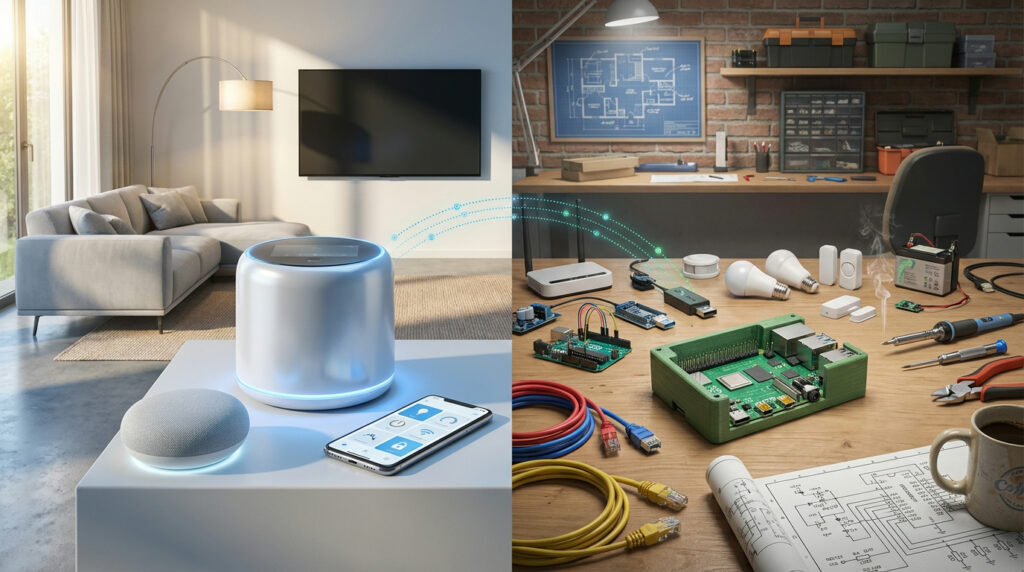
Starting your journey into home automation presents a fundamental decision. Do you choose a convenient pre-packaged solution or build a customized setup tailored to your specific needs? This choice shapes your entire experience with automated living.
The landscape of connected living has evolved dramatically. Today’s market offers both unified packages for simplicity and flexible custom builds that adapt to different skill levels. Each approach serves distinct preferences and requirements.
Your decision involves several important factors. Consider installation complexity, long-term flexibility, budget implications, and how much control you desire. This isn’t just about technology—it’s about finding the perfect fit for your lifestyle and comfort level.
This comprehensive guide walks you through every aspect of both approaches. We’ll help you make an informed decision that brings satisfaction for years. While the options may seem overwhelming initially, understanding key differences simplifies your path forward.
Key Takeaways
- Two main approaches exist: convenient all-in-one packages and flexible custom installations
- Your decision impacts installation complexity, long-term adaptability, and overall cost
- Consider your technical comfort level and how you envision your automated space evolving
- Both options have distinct advantages depending on your priorities and expertise
- This guide covers initial investment, device compatibility, security, and future-proofing
- The right choice balances convenience with personalization for your unique situation
- Understanding core differences makes selecting the ideal solution much easier
Overview of Modern Smart Home Solutions
Modern automated dwellings represent a significant evolution from basic remote controls. Today’s market offers incredible diversity, from simple plug-and-play gadgets to comprehensive automation setups. These innovations can manage nearly every aspect of your living space.
Setting the Stage for Comparison
Current connected devices utilize advanced sensors and scheduling features. They provide remote control through mobile applications. This technology delivers innovative advantages that enhance daily convenience and efficiency.
The variety available today means there’s truly a solution for every budget and technical skill level. Whether you prefer simple starters or complex configurations, options exist to match your comfort level.
Understanding the Market Trends
Major industry leaders like Amazon, Google, and Apple dominate the ecosystem. Numerous specialized manufacturers create compatible products for these platforms. This competitive landscape drives continuous improvement.
The emergence of Matter promises revolutionary connectivity across different brands. This universal protocol aims to simplify device compatibility for consumers. While facing some delays, its eventual adoption could transform how we mix products from various manufacturers.
Understanding these trends helps make future-proof decisions. Your investment will remain relevant as technology advances. Connectivity improvements create cohesive experiences regardless of your chosen approach.
Understanding All-in-One Smart Home Systems
Unified automation packages provide a straightforward entry point into connected living. These complete bundles come from a single manufacturer or ecosystem, delivering everything needed in one box.
Key Features and Integrated Devices
At the core sits a central hub that connects all your components. This command center communicates with lights, locks, thermostats, cameras, and sensors through one simple application.
Leading examples demonstrate the variety available. ADT offers security-focused integration with comprehensive monitoring. Vivint delivers premium, tech-forward equipment with sleek designs. SimpliSafe provides user-friendly wireless solutions at accessible prices.
Platforms like Amazon Alexa have evolved into powerful ecosystems. Echo speakers control thousands of compatible devices marked “works with Alexa.” This expands functionality through ZigBee and Z-Wave integration.
Pros and Cons in a Unified Package
The biggest advantage is immediate simplicity. Everything works together from day one, eliminating compatibility worries. Technical knowledge requirements drop significantly.
Support becomes more streamlined when dealing with one company. Troubleshooting and updates flow through a single channel. This creates a guided experience many users prefer.
“Complete packages remove the guesswork, letting you enjoy automation immediately rather than configuring it endlessly.”
Potential limitations include vendor lock-in and higher initial costs. Flexibility may reduce if you want devices outside the ecosystem. These solutions prioritize convenience over customization.
Understanding Custom Build Smart Home Systems
Building your automated environment piece by piece gives you complete creative control over every component. This DIY approach lets you select individual gadgets from various manufacturers rather than being locked into one brand’s ecosystem.
Flexibility and Device Customization
Custom installations excel at mixing different technologies through universal protocols. Systems like Homee’s modular BrainCube demonstrate this flexibility perfectly. You can add magnetic cubes supporting ZigBee, Z-Wave, or EnOcean standards as your needs expand.
The biggest advantage is choosing the best product in each category. You’re not limited to one company’s lineup. This creates a truly personalized experience that grows with your lifestyle.
“Custom builds let you future-proof your investment by swapping individual components when better technology emerges.”
Real-World Applications and Adaptability
These setups shine in unique living spaces with specific requirements. They integrate seamlessly with existing equipment that all-in-one packages might not support. Your configuration adapts to your home’s layout rather than forcing you to adapt to the system.
While requiring more technical knowledge initially, custom installations offer superior long-term value. Tech-savvy users appreciate the complete control over every aspect of their connected space. The effort pays off in tailored functionality that pre-packaged solutions can’t match.
smart home system comparison: All-in-One vs Custom Builds
The fundamental strengths of each automation approach become clear when examining their operational capacities. This comparison focuses on practical differences that impact daily use.
Comparison of Core Capabilities
Setup complexity varies dramatically between these approaches. Complete packages offer guided installation with pre-configured components. Custom installations require hands-on configuration but provide greater control over the final setup.
Device selection represents another key difference. All-in-one solutions limit you to compatible products within their ecosystem. Custom builds let you choose best-in-class devices across different manufacturers.
Control capabilities also differ significantly. Unified packages provide single-app management through their central hub. DIY setups may need multiple applications unless you invest in advanced integration platforms.
Both approaches support automation routines and scenes. However, custom installations often enable more sophisticated automations by combining devices from various brands. This flexibility creates unique experiences.
Voice control integration shows clear distinctions. Complete systems deeply integrate with their preferred assistant like Alexa or Google. Custom configurations can often work with multiple voice platforms simultaneously.
The learning curve impacts user experience. Packaged solutions work immediately with minimal technical knowledge. Custom builds reward those willing to invest time in learning and optimization.
Real-world scenarios highlight these differences. Arriving home might trigger lights, climate control, and music differently based on your chosen approach. Neither system type is inherently superior—the best choice depends on your technical comfort and specific requirements.
Evaluating Costs and Investment Considerations
Budget planning separates the two main approaches to automated living. Understanding the full financial picture helps you avoid unexpected expenses down the road.
Initial Setup vs. Long-Term Expenses
Complete packages typically require higher upfront investment. ADT starts around $349 for basic equipment, while Vivint demands $1,200+ for comprehensive setups. SimpliSafe offers more accessible entry points from $249.96.
Custom builds can begin with individual products under $100. However, costs accumulate as you add devices. Your final investment might match or exceed packaged solutions depending on your goals.
Ongoing subscriptions represent another key difference. Many all-in-one packages require monthly monitoring fees ranging from $21.99 to $49. Custom configurations often avoid these recurring charges entirely.
Financing options make packaged solutions more accessible. Providers like ADT offer payment plans spreading equipment costs over 60 months. This reduces the initial financial barrier for many households.
Both approaches offer long-term savings through energy management. Smart thermostats can reduce power bills by 10% when programmed correctly. Efficient devices like bulbs and motion sensors prevent wasted energy.
Replacement costs differ significantly too. Packaged solutions may require full system upgrades, while custom builds allow incremental improvements. You can swap individual components as better technology emerges.
Consider hidden expenses like professional installation ($99-$154.99) and extended warranties. These protect your investment but add to the total cost of ownership.
Device Integration and Compatibility
The true power of an automated living space lies in how well all components work together seamlessly. This connectivity determines whether your setup functions as a unified experience or just separate gadgets.
Voice Assistants and Home Hubs
Voice assistants serve as your primary control interface. Amazon Alexa offers broad compatibility with thousands of devices marked “works with Alexa.” Newer Echo speakers even support ZigBee integration directly.
Google Home benefits from Gemini upgrades that enhance conversational abilities. These improvements create more natural interactions with your connected devices.
Hub devices like the Echo Studio and Nest Hub Max act as central command centers. They process voice requests and coordinate actions across your entire automated environment.
Interconnectivity with Third-Party Products
All-in-one packages like ADT+ provide unified control through single applications. This simplifies managing both security equipment and other connected devices.
Custom builds offer greater flexibility through platforms like Vivint’s Works with Vivint. These systems can integrate Z-Wave and Zigbee devices from multiple manufacturers.
Always check compatibility before purchasing new devices. Not all products work with every voice assistant or hub, and some require specific protocol support.
Security and Monitoring in Smart Home Systems
Security considerations should guide your decision between pre-packaged and custom automation setups. Your choice impacts how you protect both physical property and digital privacy.
Complete packages often include comprehensive security features from the start. The Ring Alarm Kit offers eight components with cellular backup and local storage for $300.
Built-in Security Features
Modern security cameras provide essential monitoring capabilities. The Arlo Pro 6 delivers 2K resolution with excellent night vision, though it requires an $8 monthly subscription.
Video doorbells like Arlo’s 2K model serve as your first line of defense. Starting at just $3 monthly, they offer advanced motion alerts and cloud storage.
Smart locks from brands like Yale provide multiple access methods. These include Apple Watch compatibility and hands-free smartphone sensing for convenient security.
Data protection approaches vary between setups. All-in-one solutions typically use encrypted cloud storage, while custom builds may offer local options that keep footage on-site.
Professional monitoring services provide additional peace of mind. Companies like ADT offer 24/7 oversight from multiple centers with text alerts for faster response times.
Automation and Routine Customization
The magic of a truly responsive living space comes from automation that anticipates your needs. This transforms individual gadgets into a coordinated ecosystem working behind the scenes.
Scheduling and Smart Routines
Basic scheduling eliminates daily manual tasks. SimpliSafe’s “recipes” can automatically arm your security at 8:30 a.m. on weekdays.
Advanced routines trigger multiple actions from one command. Saying “good morning” could disarm security, adjust temperature, and start your coffee maker. These smart home routines create seamless daily experiences.
Custom installations often allow more complex logic than pre-built packages. You can create conditional actions based on occupancy, time, or weather.
Energy Management and Savings
Intelligent temperature control delivers significant savings. The Nest learning thermostat uses presence sensors and scheduling to reduce energy bills by 10%.
Smart home products like the Kelvin heater demonstrate practical automation. Set it to power on an hour before needed to ensure warmth while optimizing energy use.
Motion sensors connected to lights prevent wasted electricity. They automatically turn off when rooms are empty. This hands-free approach maintains comfort while cutting costs.
Installation and Setup: Custom vs All-in-One
Getting your automated space up and running involves a crucial installation choice. This decision affects both your initial experience and long-term satisfaction with your setup.
DIY vs. Professional Installation
Do-it-yourself approaches save money but require technical confidence. Wireless systems like SimpliSafe demonstrate how straightforward DIY can be.
Their battery-operated devices typically install in about 30 minutes. You simply place sensors and plug in the base station.
Professional installation offers guaranteed proper setup from day one. Technicians provide expert guidance on optimal device placement.
Costs range from $100 for basic ADT service to $154.99 for comprehensive setups. Vivint’s fees scale based on system complexity.
| Installation Type | Time Required | Cost Range | Best For |
|---|---|---|---|
| DIY Wireless | 30-60 minutes | $0 additional | Tech-confident users |
| Professional Basic | 2-3 hours | $100-150 | Peace of mind seekers |
| Professional Comprehensive | 4+ hours | $150-300+ | Complex setups |
Existing buildings easily accommodate wireless solutions without modifications. Hardwired installations may require wall access for cable routing.
All configurations depend on reliable internet connectivity. Mesh WiFi routers help eliminate dead zones in larger homes.
New construction offers the perfect opportunity for advanced planning. Running cables during building avoids future renovation costs.
Regulatory and Infrastructure Considerations
Navigating the legal and technical framework surrounding connected living spaces requires careful planning and awareness of local regulations. Renters must obtain landlord approval before installing any permanent modifications. Historic properties often face heritage protection restrictions that limit installation options.
Your network forms the backbone of reliable automation operation. Mesh WiFi systems provide excellent whole-home coverage for larger spaces. Many devices run on batteries, but hubs require stable power connections.
Internet dependency varies significantly between different platforms. Some solutions become unusable during outages, while others maintain core functionality locally.
| Platform | Internet Required | Offline Capability | Voice Assistant Support |
|---|---|---|---|
| Amazon Echo | Full dependency | Limited functionality | Native integration |
| Homee | Partial | Basic operations work | Reduced when offline |
| Bosch Smart Home | Optional | Full local operation | No voice when offline |
| Apple HomeKit | Minimal | Strong local processing | Limited without internet |
Data privacy represents another critical consideration. Cloud-based processing raises concerns for some users. Apple HomeKit provides end-to-end encryption with local data transmission for enhanced security.
Complex installations benefit from professional system integrators. These experts ensure proper cable management and electrical safety. Understanding these factors beforehand prevents costly surprises and ensures compliance.
Future Trends and Enhanced Connectivity
Universal protocols are emerging that could finally solve the compatibility challenges plaguing automated spaces. These innovations promise to transform how different manufacturers’ products communicate.
Embracing Matter and IoT Innovations
The Matter standard represents the most significant development in connected living connectivity. Major companies like Apple, Google, Amazon, and Samsung have committed to this universal protocol.
This industry-wide support indicates a shift toward true interoperability. Matter-certified devices will work seamlessly across different ecosystems.
Selected products already support Matter today. Eve Systems leads this adoption with compatible devices. Other manufacturers are gradually adding support to new offerings.
The Thread protocol works alongside Matter as a mesh networking foundation. This combination enhances reliability and range for connected devices.
Custom builds benefit most from Matter’s promise of brand flexibility. You can mix products freely without protocol conflicts. All-in-one systems also gain expanded device options.
While Matter represents the future, verify current compatibility before purchasing. Don’t rely solely on promised updates. Other IoT innovations include improved AI integration and energy monitoring.
Choosing platforms with Matter support helps future-proof your investment. This ensures your setup remains compatible with emerging technologies.
Customer Reviews and Expert Opinions
Independent testing in real homes provides the most honest assessment of how smart home systems actually perform. Specifications tell only part of the story—real usage reveals how equipment functions in daily life.
Insights from Industry Leaders
Organizations like CNET employ specialists with decades of security experience. Their testing team uses personal funds to purchase equipment for unbiased evaluation.
Reviewers install devices in two-story, 2,200-square-foot homes for weeks or months. This approach tests automation features, third-party integration, and app functionality thoroughly.
Recent ratings show ADT scoring 9.3/10, SimpliSafe at 9.2/10, and Vivint achieving 9.1/10. These scores reflect real-world performance rather than marketing claims.
Security experts emphasize the importance of professional monitoring and cellular backup. They recommend redundant systems for critical protection applications.
Customer feedback highlights a clear pattern. All-in-one setups receive praise for simplicity but criticism for limited flexibility. Custom builds earn appreciation for control but raise concerns about complexity.
While expert opinions provide valuable guidance, your personal needs should drive the final decision. The best smart home solution balances technical capabilities with your comfort level and priorities.
Conclusion
Ultimately, the ideal automation setup reflects your personal priorities and technical comfort level. Packaged solutions like ADT and Vivint deliver immediate simplicity with coordinated components and professional monitoring.
Custom builds offer unmatched flexibility to select the best smart home products across manufacturers. You can choose optimal lights, sensors, and cameras without brand restrictions.
Consider costs beyond initial purchase, including subscription fees and potential energy savings. Matter support promises easier device compatibility as this standard gains adoption.
There’s no universally “best” solution—your choice depends on technical expertise, budget, and specific requirements. Both approaches create comfortable, efficient living spaces.
Start small with basic devices or a starter package. Expand as you identify your needs and grow more comfortable with the technology.