
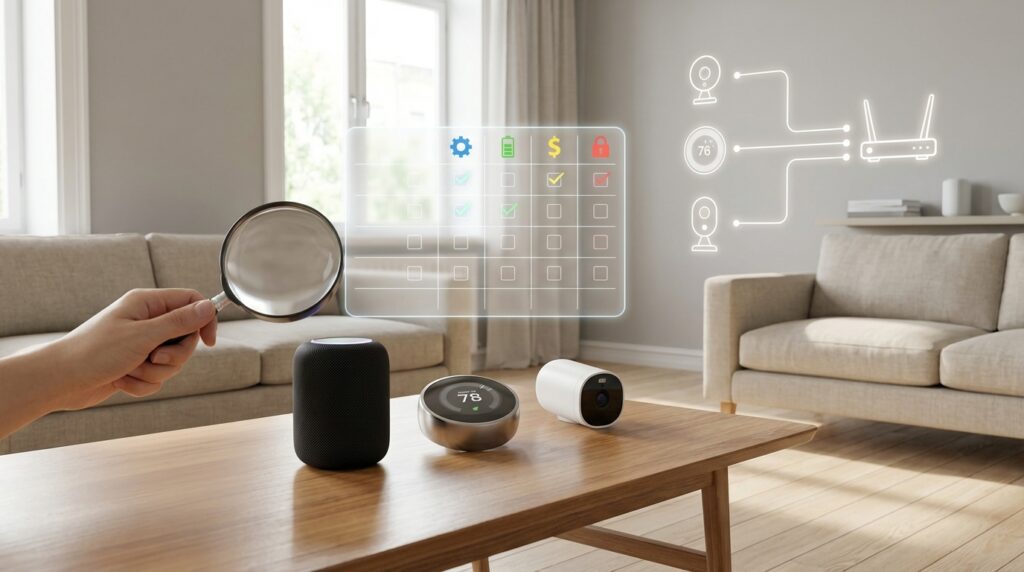
Choosing the right connected products for your living space can feel overwhelming. Flashy ads and famous brand names often grab attention first. But the real value lies in understanding which features truly matter for your daily life.
Effective evaluations go far beyond just checking price tags. You need to consider how well new additions work with your current setup. Think about installation ease, ongoing subscription costs, and whether a gadget solves real problems or just adds complexity.
We’ve tested countless connected products in actual households. Our goal is to help you spot the difference between genuinely helpful technology and devices that look impressive but underdeliver in daily use.
The best options aren’t always the most expensive or from the biggest companies. Sometimes budget-friendly choices offer better value and more practical benefits for your specific situation.
This guide walks you through everything from voice assistant compatibility to security features. We’ll help you make investments that stand the test of time. Whether you’re starting fresh or expanding your current setup, proper evaluation saves money and frustration.
Key Takeaways
- Look beyond brand reputation and cost when selecting connected products
- Consider how new additions integrate with your existing ecosystem
- Evaluate installation requirements and potential subscription fees
- Focus on devices that solve actual problems rather than creating complexity
- Budget-friendly options can sometimes offer superior value
- Test real-world performance rather than relying on marketing claims
- Future-proof your investments by considering long-term compatibility
Understanding the Smart Device Landscape
The journey from simple remote-operated appliances to AI-powered ecosystems marks a pivotal transformation in residential technology. Today’s connected products offer capabilities that were unimaginable just a few years ago.
Innovative Features Driving the Market
Modern systems now include sophisticated sensors and tracking capabilities. These features enable automated scheduling and remote control from anywhere.
We’re seeing advanced AI assistants like Alexa Plus and Gemini for Home. They provide more natural conversations than earlier voice tech. The upcoming Matter standard will revolutionize compatibility across brands.
Traditional versus Modern Home Technologies
Traditional systems required manual operation with no connectivity. Today’s innovative options include voice control, automation routines, and energy monitoring.
The gap isn’t just about convenience. It involves energy efficiency, security enhancements, and creating living spaces that adapt to you. Understanding these differences helps identify technologies that genuinely improve daily life.
Benefits of Smart Devices in Modern Homes
Many homeowners discover that automated systems provide substantial economic benefits they hadn’t anticipated. These advantages make the initial investment worthwhile over time.
Cost Savings and Efficiency Gains
Connected thermostats like the Nest Learning model can reduce energy bills by 10% or more. They learn your schedule and adjust temperatures automatically.
This eliminates wasted heating or cooling when nobody is present. The devices provide monthly reports showing exactly where you use power.
Lighting controls and programmable plugs offer similar savings. You can schedule lights to turn off when rooms are empty.
Motion sensors ensure illumination only when needed. This prevents the common problem of lights left on all day.
| Device Type | Potential Annual Savings | Key Features |
|---|---|---|
| Learning Thermostat | $100-$150 | Auto-scheduling, eco modes |
| Smart Plugs | $30-$60 | Remote control, scheduling |
| Motion Sensor Lights | $40-$80 | Presence detection, automation |
The financial benefits extend beyond just energy savings. Security systems may lower insurance premiums by 5-15%.
Water leak detectors can prevent thousands in damage. Many devices pay for themselves within two years through combined savings.
smart home comparisons
The true test of any connected product happens not in controlled labs but in actual living environments. Organizations like CNET and SafeWise conduct extensive real-world testing to provide reliable insights.
Criteria for Evaluation and Expert Insights
Professional reviewers install products in their own houses and use them daily for months. This approach reveals strengths and weaknesses that spec sheets cannot show.
Evaluation criteria include price-to-value ratio, installation difficulty, and day-to-day usability. Experts test hundreds of devices across all categories to identify genuinely useful features.
User Reviews and Real-World Performance
Customer feedback provides invaluable data that complements professional testing. We analyze patterns in reliability reports and service experiences.
Real-world performance differs from lab results due to factors like Wi-Fi strength and wall materials. Older, proven devices often outperform flashy new releases.
| Professional Testing Criteria | User Experience Factors | Our Evaluation Approach |
|---|---|---|
| Price-to-value ratio | Daily reliability | Hands-on installation |
| Feature set analysis | Customer service quality | Long-term usage testing |
| Compatibility checks | Real-home performance | Multi-user perspective |
Our expert picks balance cutting-edge technology with practical value. We view each product through different user perspectives to find the best options for various needs.
Evaluating Voice Assistants and Integration
The assistant you welcome into your living space acts as the conductor of your technological orchestra. It coordinates how all your gadgets communicate and work together. This choice impacts your daily experience more than any single device.
Compatibility determines whether your ecosystem sings in harmony or creates frustrating silences. The right platform connects everything seamlessly.
Alexa, Google Home, and Siri Compatibility
Amazon’s Alexa has evolved significantly with Alexa Plus. This advanced AI offers more conversational interactions than previous versions. Prime subscribers get it free, while others pay $20 monthly.
Google Home devices now feature Gemini for Home, replacing the older Google Assistant. This upgrade provides enhanced capabilities and more reliable voice recognition.
Apple’s Siri and HomeKit ecosystem tends to be more restrictive. However, it offers tighter security and seamless integration for Apple product users.
Ensuring Seamless Ecosystem Interactions
Voice commands have become remarkably sophisticated. You can create complex routines like “goodnight” that lock doors, adjust thermostats, and turn off lights with one phrase.
Products like WeMo Mini and Lutron Caseta demonstrate excellent cross-platform compatibility. They work with Amazon Alexa, Google Assistant, and Siri simultaneously.
IFTTT compatibility extends integration possibilities beyond native platforms. This service connects devices from different brands that wouldn’t normally work together.
When evaluating assistants, consider both current compatibility and future development. Amazon and Google receive regular updates, ensuring your investment remains relevant.
Feature-Focused Comparison: Smart Speakers, Displays, and Plugs
Your choice between entry-level and high-end connected products depends on audio priorities and visual needs. The market offers diverse options for every budget and purpose.
High-Fidelity Audio and Interactive Displays
Premium speakers like Amazon’s Echo Studio deliver spatial audio that fills rooms with rich sound. You can pair two units for true theater-quality audio.
Interactive displays add visual elements to voice control. The Nest Hub Max shows recipes step-by-step and displays security feeds. Echo Show 11’s larger screen supports video streaming with upgraded audio.
Budget-Friendly Options and Premium Picks
Google Nest Mini proves you don’t need high costs for quality. At around $50, it offers decent sound and full control features.
Smart plugs are the most affordable entry point. TP-Link Kasa Mini and Amazon Smart Plug cost about $25. They make ordinary appliances controllable via app or voice commands.
| Product Category | Price Range | Key Benefits | Best Use Cases |
|---|---|---|---|
| Premium Speakers | $200+ | Spatial audio, multi-room | Entertainment hubs, music |
| Smart Displays | $100-$250 | Visual feedback, video | Kitchens, security monitoring |
| Budget Speakers | Under $50 | Basic control, decent sound | Bedrooms, offices |
| Smart Plugs | $20-$30 | Appliance automation | Lamps, small electronics |
For comprehensive reviews of these connected devices, check professional testing results. The right choice balances features with your specific needs.
Innovative Security Systems and Smart Locks
Today’s advanced protection systems offer peace of mind through sophisticated monitoring and access control features. Modern security solutions integrate cameras, sensors, and intelligent locks into unified platforms controlled from your smartphone.
Assessing Outdoor and Indoor Security Cameras
The Arlo Pro 6 outdoor camera delivers crisp 2K resolution with a 160-degree field of view. Its AI detection distinguishes between people, vehicles, and packages to reduce false alerts.
For subscription-free operation, the Eufy S330 Floodlight Camera provides powerful 3,000-lumen lighting. It features AI tracking that follows movement across your property.
Video doorbells like the Arlo 2K model offer 180-degree head-to-toe viewing. Built-in sirens and affordable cloud storage make them essential security devices.
Smart Locks and Access Control Features
The Schlage Encode lock features the highest security rating with built-in Wi-Fi connectivity. You can lock or unlock doors remotely through the app.
Yale models offer multiple access options including Apple Watch and keypad entry. These systems eliminate anxiety about whether you remembered to lock up.
Access control now includes temporary guest permissions and specific user notifications. Integration with broader security systems creates comprehensive protection.
Lighting Solutions for a Modern Smart Home
Lighting choices can dramatically transform the mood and functionality of any living area. The right illumination setup goes beyond basic on/off switches to create environments that adapt to your daily rhythm.
Customizable Smart Bulbs and Ambiance Control
Modern bulbs offer millions of color options through intuitive apps. You can program warm tones for relaxation and bright light for productivity.
The GE Cync LED floodlight features a unique four-quadrant design. This allows different colors simultaneously in one bulb. It’s perfect for creating overlapping effects in kitchens.
“Lighting design is not just about visibility—it’s about creating emotional connections with spaces.”
Philips Hue remains the industry standard with 16 million colors. Newer models connect via Bluetooth without needing a separate hub. Voice commands work with Alexa and Google Assistant.
| Bulb Type | Key Features | Best Use Cases | Voice Control |
|---|---|---|---|
| Color Changing | 16M colors, scheduling | Living rooms, bedrooms | Alexa, Google |
| Smart Switches | Dimmer, circuit control | Older homes, hallways | Apple, Alexa, Google |
| Floodlights | Multi-zone colors | Kitchens, entryways | App control |
For spaces where ambiance matters less, consider smart switches like Lutron Caseta. One switch controls all lights on a circuit. This approach works well in older homes without replacing every bulb.
Scheduling features provide practical benefits beyond aesthetics. Lights can turn on before you arrive or simulate occupancy during vacations. Energy efficiency improves through automated control and LED technology.
Heating, Cooling, and Energy Management
The intersection of comfort and conservation finds its perfect expression in today’s intelligent heating and cooling solutions. These devices represent some of the most valuable investments for any modern residence.
Smart Thermostats and Radiant Heaters
The Nest Learning Thermostat stands out with its beautiful design featuring elegant animations. This device learns your temperature preferences automatically. It creates optimal schedules without manual programming.
Satellite sensors extend the thermostat’s capabilities throughout your entire home. The system monitors multiple rooms for consistent comfort. Monthly energy reports provide detailed consumption insights.
For targeted heating, the Kelvin smart radiant heater offers a safer alternative. Its wall-mounted design eliminates fire risks. At $340, it’s expensive but delivers energy-efficient radiant heat technology.
Optimizing Energy Consumption with App Controls
Comprehensive app controls give you remote temperature adjustment capabilities. You can set different schedules for various times and days. Automation features like pre-heating before arrival enhance convenience.
Eco modes automatically reduce power consumption when you’re away. Geofencing adjusts settings based on your smartphone’s location. This creates one of the best smart energy management approaches available.
While installation requires planning, the investment pays for itself quickly. Many utility companies offer rebates for these efficient systems. Your smart home becomes both comfortable and cost-effective.
Connectivity and Network Infrastructure
Behind every responsive voice command and instant automation lies an often-overlooked component: your Wi-Fi infrastructure. A robust network forms the foundation that keeps all your gadgets communicating smoothly.
Without strong connectivity, even premium devices suffer from frustrating delays and disconnections. This section explores how to build a network that supports your growing ecosystem.
Wi-Fi Mesh Systems and Router Integration
Traditional routers often struggle with coverage in larger spaces. Mesh systems like the Nest WiFi Pro use multiple units that work together seamlessly.
Each point handles up to 100 devices using three separate bands to prevent congestion. The system automatically connects your phone to the fastest available unit as you move through your house.
Controlled through the Google Home app, these platforms offer simple installation despite their advanced capabilities. While premium-priced, they deliver performance that justifies the investment for device-heavy households.
| Router Type | Max Devices Supported | Coverage Area | Key Security Feature |
|---|---|---|---|
| Traditional Router | 20-30 | 1,500 sq ft | Basic password protection |
| Mesh System (Base Unit) | 100+ | 2,200 sq ft | Separate guest network |
| Mesh System (3-Pack) | 300+ | 6,600 sq ft | Device isolation controls |
Ensuring Reliable Device Interoperability
Your gadgets’ ability to work together depends on both your network and supported standards. Choose devices that use common protocols like Wi-Fi or Zigbee.
Separate guest networks provide security by isolating visitor access from your main system. This prevents guests from accidentally interfering with your connected devices.
Quality infrastructure might seem less exciting than new gadgets, but it determines whether your tech works reliably every day. The right setup eliminates connectivity headaches before they start.
Automating Daily Life with Smart Devices
True convenience emerges when individual gadgets work together as a unified system that simplifies daily routines. This integration transforms separate tools into a cohesive environment that anticipates your needs.
Voice Commands and Routine Automation
Speaking to your assistant provides the simplest way to control connected devices. A quick “turn off the lights” command beats searching for switches or opening apps every time.
Routine automation bundles multiple actions into single phrases. Say “good morning” to raise blinds, start coffee, and get weather updates simultaneously. These sequences handle repetitive things you do daily.
Smart plugs with Away Mode randomly toggle devices when you travel. This creates the appearance of occupancy to enhance security. The feature deters burglars watching for empty houses.
Modern assistants connect to services beyond your living space. Alexa integrates with music streaming, ride requests, and food delivery apps. This extends automation possibilities throughout your day.
The key is identifying routine tasks that devices can handle automatically. Locking doors at bedtime or adjusting lights at sunset become effortless. Your environment responds to you instead of requiring constant manual control.
Balancing Price, Features, and Brand Reputation
The most successful technology investments emerge from thoughtful evaluation of long-term value rather than initial price tags. Finding the right balance requires looking beyond flashy marketing to understand what truly matters for your specific situation.
Cost Versus Value Analysis
Budget-friendly options like the Wyze Cam V4 demonstrate impressive value at just $35.98. This camera delivers 2.5K resolution and color night vision, competing with models costing three times more.
Subscription costs dramatically impact total ownership expenses. A $200 camera with an $8 monthly fee adds nearly $300 over three years. Subscription-free alternatives like certain Eufy products eliminate ongoing fees.
| Device Category | Price Range | Key Value Factors | Long-term Considerations |
|---|---|---|---|
| Security Cameras | $35-$300+ | Resolution, subscription needs | Software updates, cloud storage |
| Smart Thermostats | $100-$250 | Energy savings, learning features | Potential utility rebates |
| Smart Plugs | $20-$40 | Basic automation, compatibility | No ongoing costs, simple setup |
Premium products from established brands often justify higher prices through superior build quality and better customer service. Brand reputation matters significantly for devices requiring ongoing software support.
Some products genuinely pay for themselves. Smart thermostats can reduce energy costs by 10% or more, becoming free within one to two years. Focus on features you’ll actually use rather than paying for unnecessary extras.
The best approach involves determining must-have requirements first. Then compare only products meeting those needs. Consider ecosystem costs—sometimes paying more for seamless integration delivers better value than mixing cheaper, incompatible devices.
Emerging Trends and Future Developments
The next wave of residential technology brings exciting developments that will reshape how we interact with our living spaces. Major advancements in AI and connectivity standards promise to solve current compatibility challenges while creating more intuitive experiences.
Integration with Advanced AI Assistants
Today’s voice assistants are evolving beyond simple command responses. Platforms like Alexa Plus and Gemini for Home now understand context and remember previous requests.
This creates more natural conversations that feel helpful rather than robotic. Your systems will eventually anticipate needs based on behavior patterns.
Instead of programming every routine manually, AI analyzes your data to suggest automations. It might notice you typically adjust temperatures at certain times.
The Role of Matter and IoT Standards
The long-awaited Matter standard represents a significant breakthrough for device interoperability. Major companies including Amazon, Apple, and Google have committed to this universal protocol.
When fully implemented, Matter-certified devices will work together seamlessly regardless of manufacturer. This eliminates the frustration of incompatible things from different brands.
Complementary standards like Zigbee and Thread continue improving too. They enable more reliable connections while using less power. People can finally mix and match products confidently.
While rollout timelines remain uncertain, these developments point toward a more unified future. Choosing current devices with upgrade paths ensures you’ll benefit as standards mature.
Expert Tips for a Seamless Smart Home Setup
Strategic installation practices transform individual gadgets into a cohesive system that enhances daily living. Proper planning prevents frustrating connectivity issues and ensures reliable performance.
Installation Best Practices
Begin with simple devices like smart plugs and bulbs. These entry-level options teach you basic app connectivity without complexity.
Test your Wi-Fi coverage throughout your entire space before installing anything. Consider upgrading to a mesh network if you find weak signal areas.
For security cameras, check viewing angles through the app before permanent mounting. This saves time and prevents wall damage from repositioning.
Optimizing Device Connectivity and Functionality
Place your router centrally and keep hubs away from interference sources like microwaves. Ensure battery-powered devices stay within good signal range.
Create separate networks for guests and your connected system. This improves security by isolating access.
Keep detailed records of installed devices and login credentials. This data becomes invaluable for troubleshooting and warranty claims.
| Installation Type | Best For | Skill Level | Time Required | Tools Needed |
|---|---|---|---|---|
| DIY Plug-in Devices | Smart plugs, speakers | Beginner | 5-15 minutes | Smartphone, app |
| Professional Hardwired | Thermostats, security systems | Expert | 1-3 hours | Electrical tools |
| Wireless Setup | Cameras, sensors | Intermediate | 20-45 minutes | Ladder, mounting hardware |
Regular firmware updates provide critical security patches and performance improvements. Test automation routines thoroughly before relying on them for daily use.
Conclusion
Building your ideal connected environment requires more than just comparing specs and prices. The best smart home setup emerges when you match technology to your actual daily routines and security needs.
Start with devices that solve immediate problems rather than chasing every new feature. Our top picks balance reliability with practical value for most homes.
Remember that privacy and home security should guide your choices. The right options provide peace of mind while saving energy and simplifying your life.
Whether you prefer budget-friendly devices or premium systems with professional monitoring service, there’s a solution for every household. The investment pays off in convenience and control that grows with your comfort level.