
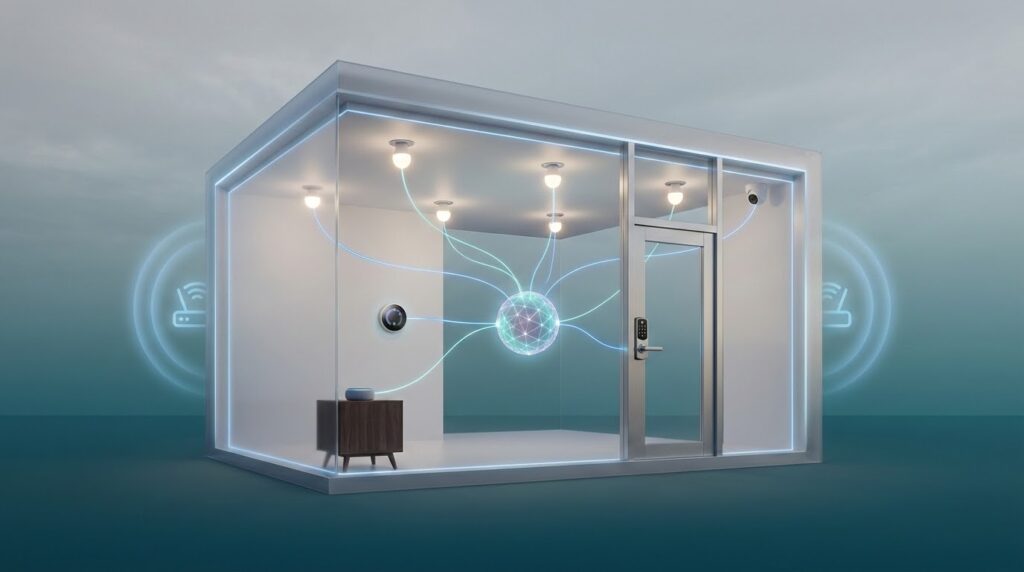
Imagine buying a new gadget for your house, only to find it won’t work with your existing setup. This frustration has been common with connected devices. Different brands often use their own systems that don’t communicate well together.
A new technical standard aims to solve this problem. Major technology companies joined forces to create a unified approach. Amazon, Apple, Google, and others collaborated through the Connectivity Standards Alliance.
This initiative began in December 2019 as Project Connected Home over IP. The goal was simple: make different products work together seamlessly. The specification reached version 1.0 in October 2022, marking a significant milestone.
This standard operates on Internet Protocol, allowing local network control. Your gadgets can function even without internet access. This enhances reliability and protects your privacy by reducing cloud dependence.
Throughout this guide, you’ll discover how this technology transforms device connectivity. We’ll explore technical foundations, security features, and integration processes. You’ll learn what to expect from certified products in the evolving ecosystem.
Key Takeaways
- A unified standard enables different brands to work together seamlessly
- Major technology companies collaborated to create this interoperability solution
- Devices can operate locally without requiring constant internet connection
- The specification reached its first official version in late 2022
- This approach simplifies setup and reduces compatibility confusion
- Local control enhances reliability and privacy for connected products
- Certified gadgets are designed to work across multiple ecosystems
Understanding the Basics of Matter in Smart Homes
What sets this approach apart is its position as an application-layer protocol that builds upon standard IP communication rather than creating new radio technologies. Unlike Zigbee or Z-Wave, it uses IPv6-based networking that works with existing infrastructure.
This standard allows products to connect with multiple voice assistants simultaneously. Household members can control the same light or thermostat using Amazon Alexa, Apple Siri, or Google Assistant. Compatibility concerns become a thing of the past.
The architecture operates at the application layer of networking models. It can theoretically function on any IPv6-enabled network. Current official support includes Wi-Fi, Ethernet, and Thread for different device needs.
This isn’t a single technology but a unified framework. It incorporates Wi-Fi for high-bandwidth products and Thread for low-power battery-operated devices. The system creates harmony between different types of equipment.
A key feature called multi-fabric enables simultaneous connections to multiple controllers. You can add one device to Google Home, Apple Home, and other platforms at the same time. This eliminates ecosystem lock-in that previously limited consumer choice.
The standard simplifies the connected living experience by reducing dependency on proprietary hubs. Managing different manufacturers’ products through separate apps becomes unnecessary. This represents a significant shift toward interoperability and local control.
Background and History of Matter Protocol
December 2019 marked a pivotal moment as leading tech corporations united to address the interoperability challenges facing modern households. Amazon, Apple, Google, Samsung SmartThings, and the Zigbee Alliance formed the Project Connected Home over IP working group.
This collaborative effort aimed to simplify development for manufacturers while ensuring compatibility across different ecosystems. The initiative quickly expanded to include over 550 companies like IKEA, Huawei, and Schneider.
The project underwent rebranding to become the Matter standard, creating a recognizable trust mark for consumers. While the software development kit remains royalty-free, certification requires membership fees to maintain quality control.
Originally scheduled for late 2020, the specification launched in October 2022 after extensive refinement. This timing addressed growing consumer frustration with fragmented platforms and incompatible products.
The certification process uses public key infrastructure to verify device authenticity. This ensures that certified equipment works seamlessly across different systems without compatibility issues.
The Evolution of Matter: Versions and Timeline
Since its debut, this interoperability framework has evolved through multiple versions. Each update adds new capabilities to the specification.
The initial version 1.0 launched in October 2022. It supported common equipment like lights, locks, and thermostats. Version 1.1 followed with bug fixes.
Version 1.2 expanded the ecosystem significantly. It added nine new device types including refrigerators and dishwashers. Safety equipment like smoke alarms also joined the standard.
Energy management arrived with version 1.3 in 2024. This update enabled devices to report usage data. It supported sustainability goals for consumers.
Version 1.4 brought renewable energy systems into focus. Batteries, solar panels, and heat pumps gained support. The specification became a comprehensive energy solution.
Subsequent updates improved user experience. Version 1.4.1 added NFC onboarding for easier setup. Version 1.4.2 enhanced security protections.
Version 1.5 marked a major milestone with camera support. Soil sensors and advanced energy features also debuted. The specification continues with biannual updates.
Matter Protocol Smart Home Integration: Interoperability and Benefits
Consumers can now enjoy unprecedented freedom when selecting connected products for their living spaces. The standard’s core strength lies in true interoperability across different brands and systems.
Multi-admin capability allows a single device to connect to multiple controllers simultaneously. Family members can control the same equipment using Apple HomeKit, Google Home, or Amazon Alexa. This eliminates vendor lock-in and lets people choose products based on quality rather than compatibility.
The Connectivity Standards Alliance maintains rigorous certification standards. Their Distributed Compliance Ledger stores verification data for all certified equipment. This ensures devices meet strict interoperability requirements.
Major platforms received software updates in late 2022 to become Matter controllers. Google Home, Samsung SmartThings, and other ecosystems now support the standard. Existing hubs can control new certified devices seamlessly.
| Benefit | Before Matter | With Matter |
|---|---|---|
| Setup Process | Complex, app-dependent | Quick, standardized |
| Reliability | Cloud-dependent | Local network control |
| Internet Outage | Devices often unusable | Continued operation |
| Platform Choice | Limited to one ecosystem | Multiple controllers |
Some manufacturers limit advanced features to their native apps. Basic controls work through Matter, but specialized functions may require original applications. Consumers should understand these trade-offs when building their systems.
Technical Foundations of Matter for Smart Home Devices
Unlike previous proprietary systems, this unified approach leverages standard internet protocols that most households already use. It operates at the application layer of networking models, focusing on device commands rather than creating new radio technologies.
The standard uses IPv6 addressing for all communication. This allows seamless integration with existing local networks. Devices can discover each other using mDNS technology.
Thread serves as a low-power mesh networking option for battery-operated equipment. This mesh network extends range through interconnected devices. Not all Thread equipment supports this interoperability standard—some use proprietary protocols instead.
| Network Type | Purpose | Best For | Key Features |
|---|---|---|---|
| Wi-Fi | High-bandwidth communication | Cameras, displays | Fast data transfer, widespread availability |
| Ethernet | Reliable wired connection | Hubs, stationary devices | Stable performance, no interference |
| Thread | Low-power mesh network | Sensors, battery devices | Self-healing mesh, extended range |
Border routers bridge Thread mesh networks to Wi-Fi or Ethernet systems. These routers forward traffic without reading encrypted data contents. This maintains security while enabling cross-network communication.
The architecture supports multiple physical layers while maintaining consistent control. This flexibility distinguishes it from older proprietary standards. Equipment can choose the most suitable transport for its needs.
Hardware and Software Requirements for Matter-Enabled Devices
Building a compatible ecosystem requires specific hardware components that manage communication between different products. A central controller coordinates all connected equipment on your network.
Many popular speakers and displays already function as controllers. Amazon Echo devices from the fourth generation onward support this role. Apple HomePods, Google Nest Hubs, and Samsung SmartThings hubs also work.
Thread border routers provide essential connectivity for low-power equipment. Several products combine both controller and router capabilities in one unit.
| Device Type | Controller Function | Border Router | Examples |
|---|---|---|---|
| Smart Speakers | Yes | Yes | Echo 4th Gen, HomePod 2nd Gen |
| Streaming Devices | Yes | Yes | Apple TV 4K, Google TV Streamer |
| Wi-Fi Systems | Yes | Yes | Eero 6 Pro, Nest Wifi Pro |
| Dedicated Hubs | Yes | Yes | Echo Hub, SmartThings Station |
The setup process uses Bluetooth Low Energy for initial pairing. Your phone transfers network credentials securely during commissioning. After connection, devices communicate through Wi-Fi or Thread networks.
Software requirements include updated companion applications. Android users need version 8.1 minimum, with 12+ recommended. iOS requires version 16 or higher for proper functionality.
QR codes or numeric setup codes enable secure device pairing. Preserve this information for future troubleshooting. Ensure your network supports 2.4 GHz Wi-Fi for compatible equipment.
Home Assistant OS users can install the server add-on. This connects the fabric through a WebSocket connection. Different platforms support various device types for expanded compatibility.
Enhancing Security and Local Control with Matter
Security stands as a core pillar in the design of this interoperability standard. The Connectivity Standards Alliance uses public key infrastructure for strong validation.
Each certified product gets a unique device attestation certificate. This ensures you are adding authentic, up-to-date equipment to your system.
A distributed ledger maintains a transparent record of all certified devices. Controllers check this ledger during setup to block counterfeit items.
Local control is a major benefit. Commands travel directly from your phone to the device on your local network. They do not need to route through a cloud server first.
| Security Feature | Traditional Systems | Matter-Enabled Systems |
|---|---|---|
| Authentication | Varies by manufacturer | Standardized PKI & certificates |
| Data Path | Often goes to the cloud | Local network preferred |
| Internet Outage | Many features lost | Local control continues |
| Encryption | Proprietary or weak | End-to-end encryption standard |
End-to-end encryption protects all communication. Even routers passing data cannot decrypt the contents. This safeguards your privacy.
While local control reduces cloud risks, review manufacturer data policies. The Matter 1.4.2 update further strengthened these network protections.
Future Trends and Expansion in the Matter Ecosystem
As manufacturers embrace this unified approach, upcoming specification updates will introduce support for entirely new categories of connected equipment. The working group plans to add ambient motion sensing, environmental controls, and closure sensors. Major appliances will also join the expanding ecosystem.
Updates occur every six months, ensuring continuous evolution. Each release brings enhanced features and new device types. Energy management capabilities will grow significantly, enabling sophisticated automation scenarios.
Current implementation faces some challenges. Multiple Thread networks can cause connectivity problems. Glitches sometimes occur when controlling equipment through different platforms simultaneously.
Industry leaders hope the certification logo becomes as trusted as Wi-Fi branding. Manufacturers balance interoperability with unique features. Basic functions work universally while advanced capabilities may remain platform-specific.
The technology shows potential beyond traditional connected devices. It could expand into energy management systems and commercial automation. Widespread seamless functionality across all platforms will take time to achieve.
Integrating Matter with Popular Smart Home Ecosystems
Four leading ecosystems now support seamless integration across various manufacturers’ products. Google Home, Apple Home, Amazon Alexa, and Samsung SmartThings all work with certified equipment.
Each platform offers unique controller capabilities. You can use multiple systems simultaneously with the same devices.
| Platform | Controller Devices | Thread Support | Voice Assistant |
|---|---|---|---|
| Google Home | Nest Hub, Nest Audio, Chromecast | Nest Wifi Pro, Hub Max | Google Assistant |
| Apple Home | HomePod, Apple TV 4K | HomePod Mini | Siri |
| Amazon Alexa | Echo devices, Echo Hub | Eero routers, Echo Studio | Alexa |
| Samsung SmartThings | SmartThings Station, Smart TVs | SmartThings Hub v2 | Bixby |
The setup process uses your platform’s companion app. Scan the QR code to add new equipment. You can name each device for easy organization.
Multi-fabric capability lets one device work with multiple controllers. Family members can use their preferred voice assistant. Basic controls function across all platforms.
Advanced features may require the manufacturer’s original app. Voice commands work through Google Assistant, Siri, or Alexa. Routines can include devices from different brands.
Conclusion
The frustration of incompatible gadgets may soon become a distant memory as interoperability standards mature. This unified approach represents a major breakthrough for connected living spaces.
Success depends on ongoing collaboration among the 550+ member companies. Platform providers must fully implement the specification rather than limiting functionality.
Today’s practical benefits include simplified setup and multi-platform support. Local control and improved security enhance the user experience. Regular updates expand device categories and capabilities.
When shopping for new equipment, look for the certification logo. This ensures compatibility with your existing ecosystem. It also provides flexibility to change platforms in the future.
The foundation is solid and the trajectory remains positive. Building with certified devices offers future-proofing for your connected space.