
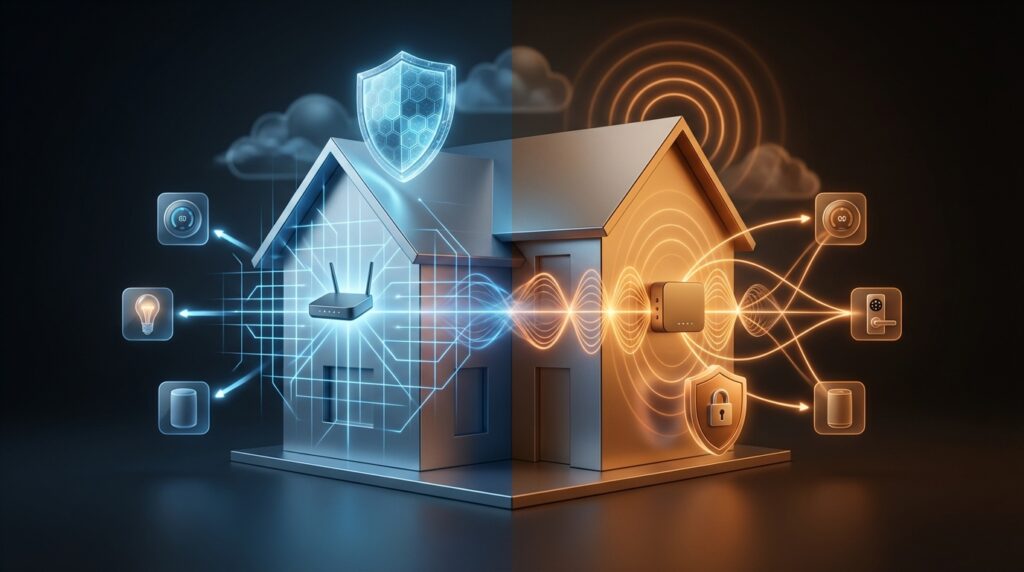
Choosing the right connectivity standard for your automated living space can feel overwhelming. With so many options available, understanding the core differences between leading protocols helps you build a system that works seamlessly.
Two prominent standards dominate the conversation around connected living environments. Each offers unique approaches to device communication, security, and compatibility. Your choice between them significantly impacts how well your gadgets work together.
This guide breaks down the essential characteristics of both technologies. We’ll explore their network architectures, security frameworks, and real-world performance. By the end, you’ll know which solution aligns best with your automation goals.
Key Takeaways
- Understand the fundamental differences between IP-based and non-IP connectivity approaches
- Learn how each standard handles security and device interoperability
- Discover which protocol works better for different types of smart home gadgets
- See how major tech companies influence protocol development and adoption
- Gain insights into reliability factors for long-term home automation systems
- Compare real-world performance considerations for various use cases
- Make informed decisions based on your specific needs and future expansion plans
Introduction to Smart Home Protocols
The foundation of every efficient smart home lies in its communication backbone. This invisible framework allows your gadgets to work together. These rules are called protocols.
Overview of Smart Home Ecosystems
Imagine your smart home as a team. Each device, like a light or thermostat, is a player. Protocols are the common language they use to cooperate.
Without this shared language, you’d have isolated gadgets. Your smart lock wouldn’t talk to your lights. This creates a frustrating experience. A unified ecosystem solves this.
The right protocol ensures smooth operation. It affects how quickly commands are executed. It also governs how securely your data is handled.
| Feature | With Standardized Protocols | Without Standardized Protocols |
|---|---|---|
| Device Compatibility | Seamless integration across brands | Limited to single-brand ecosystems |
| Setup Process | Simplified and user-friendly | Complex and often frustrating |
| System Security | Consistent, robust protection | Varies greatly, potential vulnerabilities |
| Future Expansion | Easy addition of new devices | Risk of incompatibility with new tech |
Importance of Standardized Communication
Standardization is key for a growing smart home. It future-proofs your investment. New devices can join the network easily.
This approach offers greater flexibility in product choice. You are not locked into one manufacturer. You can select devices that best fit your needs and budget.
Ultimately, standardized communication creates a harmonious environment. Your devices communicate effectively, making daily life more convenient and secure.
What is Matter?
The push for universal smart home communication has found its champion in a new industry-backed initiative. This protocol represents a significant shift toward true device interoperability.
Core Features and Objectives
Developed by the Connectivity Standards Alliance, this standard builds upon Internet Protocol foundations. It leverages existing Wi-Fi and Ethernet infrastructures for seamless integration.
The protocol’s design focuses on simplicity and reliability. Manufacturers can adopt it without licensing fees, encouraging widespread adoption across product categories.
| Setup Aspect | Traditional Systems | Matter-Enabled Systems |
|---|---|---|
| Device Discovery | Brand-specific apps required | Universal QR code scanning |
| Platform Integration | Limited to single ecosystems | Works with multiple assistants |
| Expansion Flexibility | Restricted by brand compatibility | Open standard supports diverse devices |
Interoperability and Compatibility Benefits
One of the most significant advantages is cross-platform functionality. Devices certified for this standard work seamlessly across major smart home ecosystems.
This connectivity approach future-proofs your investment in smart devices. You can mix products from different manufacturers while maintaining full functionality.
The standardization ensures that your connected home grows with your needs. New devices integrate easily, creating a truly unified automation experience.
Exploring Z-Wave Protocol
With its mesh networking architecture, Z-Wave creates robust communication pathways throughout your living space. This established protocol has powered smart homes since 1999, offering reliable wireless communication.
Fundamental Principles of Z-Wave
Z-Wave operates on the 800-900 MHz frequency band, specifically 908.42 MHz in the United States. This sub-gigahertz range provides excellent wall penetration and avoids interference from common 2.4 GHz devices.
The mesh networking approach is Z-Wave’s core strength. Each powered device acts as a repeater, extending the network’s reach. Traditional Z-Wave networks support up to 232 devices, sufficient for most residential applications.
Advancements with Z-Wave LR
Z-Wave Long Range represents a significant leap forward. This extension quadruples the communication range, reaching up to one kilometer in open space.
The network capacity expands dramatically to 4,000 nodes. This opens possibilities for large properties and commercial buildings. Best of all, Z-Wave LR maintains backward compatibility with existing hubs.
| Feature | Standard Z-Wave | Z-Wave Long Range |
|---|---|---|
| Maximum Range | Approximately 250 feet indoors | Up to 1 kilometer line-of-sight |
| Network Capacity | 232 devices | 4,000 nodes |
| Frequency Band | 908.42 MHz (US) | Same frequency with enhanced protocol |
| Ideal Application | Residential smart homes | Large properties & commercial use |
matter vs zwave
When comparing smart home communication foundations, the architectural approach creates the most significant distinction. These technologies build their networks in fundamentally different ways.
Direct Comparison of Core Technologies
Matter operates as an application layer that rides on existing IP networks. It uses Wi-Fi, Ethernet, or Thread for the actual data transmission.
This IP-based design means it leverages your home’s current infrastructure. The technology focuses on high-level device interaction standards.
Z-Wave functions as a complete protocol stack from physical layer upward. It creates its own dedicated mesh network using sub-gigahertz frequencies.
This standalone approach ensures reliable communication separate from Wi-Fi congestion. The system specializes in low-bandwidth, battery-efficient devices.
Key Differences in Application Layers
Device support varies dramatically between these approaches. Matter accommodates high-bandwidth gadgets like cameras and smart TVs.
Z-Wave excels with security sensors, locks, and switches where reliability trumps speed. Each protocol serves different smart home needs effectively.
| Feature | Matter Approach | Z-Wave Approach |
|---|---|---|
| Network Foundation | IP-based using existing infrastructure | Dedicated mesh network on sub-GHz bands |
| Device Types Supported | Cameras, speakers, TVs, high-bandwidth devices | Sensors, locks, switches, low-power devices |
| Ecosystem Integration | Works with multiple voice assistants | Requires Z-Wave specific gateway |
| Communication Range | Depends on underlying network (Wi-Fi/Thread) | Mesh network extends through repeating devices |
| Power Consumption | Varies by underlying technology | Optimized for battery-efficient operation |
The choice between these protocols depends on your specific home automation goals. Each offers distinct advantages for different types of connected devices.
Performance Comparison: Speed, Range and Reliability
The true test of any smart home system comes down to how reliably it responds when you need it most. Performance isn’t just about raw speed—it’s about finding the right balance for your specific needs.
Latency and Throughput Analysis
Response time matters greatly for daily use. One protocol offers very low latency since it operates on a dedicated network. This means your commands execute instantly without competing traffic.
The other approach shares bandwidth with your internet activities. During network congestion, simple commands might experience slight delays. However, most users won’t notice this difference for basic functions.
Data transmission rates vary significantly between these technologies. For controlling lights, locks, and sensors, you don’t need high-speed throughput. Reliability trumps raw speed for these essential home devices.
Network Stability Considerations
Network stability separates professional setups from basic ones. Mesh networking creates multiple pathways for signals to reach their destination. If one route fails, the system automatically finds another.
This self-healing capability ensures your smart home keeps working smoothly. Every powered device strengthens the network, extending coverage throughout your living space.
Range performance also differs in real-world conditions. While both claim similar distances, lower frequencies penetrate walls better. This provides more consistent coverage in larger homes. Understanding these protocol fundamentals helps you choose the right foundation.
Security Approaches: End-to-End Encryption & Authentication
Protecting your connected home starts with understanding how security protocols safeguard your privacy and data. These frameworks determine who can access your system and how information travels between devices.
Matter’s Security Enhancements
The newer standard implements Public Key Infrastructure with advanced encryption algorithms. This approach ensures data remains protected from source to destination.
Every certified product undergoes rigorous testing before joining your network. This prevents unauthorized gadgets from accessing your automated environment. The system also includes built-in cloud security for remote management.
Z-Wave’s Encryption and Authentication
This established technology uses military-grade AES-128 encryption for all communications. Each device must authenticate itself during the pairing process.
The local-first approach keeps sensitive information within your home network. This appeals to privacy-focused users who prefer minimal external data routing. The mature codebase has been tested across thousands of installations worldwide.
Both systems offer robust protection when properly configured. Your choice depends on whether you prioritize cloud integration or local network security.
Device Compatibility and Ecosystem Integration
Your ability to choose the best products depends heavily on how well they integrate into your existing setup. True flexibility comes when devices work together regardless of manufacturer.
Interoperability Across Platforms
One protocol’s primary advantage is cross-platform functionality. Certified smart home devices connect seamlessly with major voice assistants and controllers.
This means you can control lights with Siri, adjust thermostats through Google Assistant, and manage locks via Alexa. Your investment remains protected even if you switch ecosystems later.
Integration with Existing Smart Home Devices
The other approach requires a specific controller or hub to manage communication. Once established, thousands of certified home devices create a reliable network.
Bridge technology solves integration challenges for mixed systems. These translators allow older protocols to coexist with newer standards.
| Integration Feature | Platform-First Approach | Hub-Centric Approach |
|---|---|---|
| Voice Assistant Support | Works with multiple assistants simultaneously | Typically requires hub integration first |
| Setup Complexity | Simplified through QR codes and apps | Requires initial hub configuration |
| Device Compatibility | Growing library of certified products | Over 3,000 certified devices available |
| Mixed System Support | Bridges enable legacy device integration | Native support within hub ecosystem |
Your choice depends on whether you prioritize easy multi-platform access or deep automation capabilities within a controlled environment.
Understanding Home Automation and Device Applications
The real magic of a connected home comes alive when your devices work together automatically. Your living space transforms from a collection of individual gadgets into an intelligent environment that anticipates your needs.
Role of Protocols in Automation Scenarios
Your chosen communication standard fundamentally shapes what’s possible. One approach excels at creating cohesive experiences across different brands and platforms.
Imagine your lights, locks, and thermostat working in perfect harmony. They respond to single commands regardless of manufacturer. This interoperability opens doors to advanced features like multi-room audio and video streaming.
The other technology shines in reliability for time-critical scenarios. When motion detection should instantly trigger outdoor lighting, its dedicated network ensures consistent performance. Complex “Good Night” scenes can lock doors, adjust temperatures, and control lighting in coordinated sequences.
For practical home automation, consider your priorities. One protocol provides flexibility and broad device choice. The other offers proven reliability for security and access control functions.
Your smart home devices become truly intelligent when they communicate effectively. The right foundation ensures your automation scenarios work seamlessly every time.
Mesh Networking vs IP-Based Connectivity
The architecture of your smart home’s communication backbone fundamentally shapes its reliability and coverage. Two primary models dominate: dedicated mesh networks and IP-based systems.
Each offers a unique path for your devices to communicate. Your choice impacts everything from signal range to how well your system handles interference.
Advantages of a Dedicated Mesh Network
A true mesh topology creates a self-healing web of connectivity. Every powered device acts as a repeater, extending the network’s reach.
If one pathway is blocked, signals automatically find another route. This eliminates single points of failure for exceptional reliability. The network actually grows stronger as you add more devices to your home.
This approach uses a dedicated frequency band. It operates completely separate from your Wi-Fi, avoiding competition for bandwidth with streaming or gaming. This ensures consistent performance for critical devices like sensors and locks.
The Flexibility of IP-Based Solutions
IP-based connectivity leverages your existing home infrastructure, like Wi-Fi and Ethernet. This can simplify initial setup for many users.
One of its underlying protocols, Thread, also provides mesh networking capabilities. This combines the benefits of IP connectivity with the resilience of a mesh architecture. It’s an excellent solution for creating robust whole-home coverage.
This method supports high-bandwidth devices that a simpler mesh couldn’t handle. It’s ideal for security cameras and smart displays that require more data.
| Feature | Dedicated Mesh Network | IP-Based Connectivity |
|---|---|---|
| Network Topology | True mesh; all powered devices are repeaters | Star or mesh (when using Thread) |
| Frequency Band | Dedicated (e.g., 900MHz) | Shared (2.4GHz/5GHz Wi-Fi bands) |
| Interference | Minimal, operates on separate band | Potential for Wi-Fi congestion |
| Ideal For | Low-power sensors, locks, reliability | High-bandwidth devices, easy integration |
| Scalability | Network strengthens with each device added | Dependent on underlying router capacity |
For a deeper dive into how these technologies compare in practice, this detailed analysis offers valuable insights. The best choice depends on your specific home layout and the types of devices you plan to use.
Power Consumption and Efficiency Trade-offs
Battery life becomes a practical concern when your smart home relies on numerous wireless sensors and detectors. The energy efficiency of your chosen protocol directly determines maintenance frequency for these essential components.
Z-Wave stands out with remarkably low power consumption of approximately 2.5mA. This efficiency allows many sensors to operate for years on a single battery. The technology achieves this by waking only when needed, transmitting data quickly, then returning to sleep mode.
Matter devices show variable power consumption depending on their underlying transport layer. Wi-Fi-based implementations consume significantly more energy than Thread-based alternatives. This makes Thread the preferred choice for battery-operated applications within the Matter ecosystem.
The practical implication is clear: if your setup includes many battery-powered sensors, Z-Wave’s efficiency means less maintenance. For mains-powered devices like smart plugs, power differences become negligible.
Z-Wave LR enhances efficiency further with advanced modulation schemes. This extends both range and battery life, making it ideal for outdoor or remote sensors. Your choice should align with the types of devices dominating your smart home landscape.
Future Trends and Evolving Standards
The landscape of connected living is constantly shifting. New innovations promise to make our homes even smarter and more integrated. Understanding these trends helps you build a system that will remain relevant for years to come.
Innovations in Smart Home Communication
Major industry players are heavily investing in a new, unified approach. This collective effort, led by the Connectivity Standards Alliance, aims to simplify device integration. The goal is a future where compatibility is a given, not a challenge.
This doesn’t mean older, reliable protocols will disappear. Instead, we are moving toward a harmonious coexistence. Many manufacturers now create products that support multiple communication methods. This gives you incredible flexibility when starting your smart home setup.
Hubs are becoming smarter, often acting as bridges between different technologies. This allows your existing devices to work seamlessly within newer ecosystems. The practical result is that your investment in smart technology is more future-proof than ever.
| Trend | Impact on Consumers | Expected Timeline |
|---|---|---|
| Unified Standard Adoption | Simpler setup and broader device choice | Next 1-2 years |
| Multi-Protocol Hubs | Seamless integration of old and new devices | Currently available, expanding |
| Enhanced Wireless Tech | Better range and reliability for all devices | Ongoing development |
| Focus on Security | Stronger built-in protection for privacy | Continuous improvement |
Real-World Use Cases and Applications
Practical applications demonstrate why certain connectivity standards excel in specific real-world scenarios. Different environments demand unique solutions for reliable automation.
Your choice impacts how well your system performs in daily life. Let’s explore where each approach shines brightest.
Residential and Multi-Dwelling Implementations
In typical homes, one protocol offers seamless integration with popular voice assistants. Families appreciate controlling all their devices through any interface.
Multi-dwelling units benefit from extended range technology. Property managers can cover entire buildings with thousands of sensors on one network.
Large homes with challenging layouts need reliable wall penetration. Mesh networking ensures coverage reaches every corner.
Commercial and Outdoor Scenarios
Outdoor applications demand weather-resistant reliability. Perimeter security systems need kilometer-range coverage without repeaters.
Driveway lighting and garden controls work seamlessly with long-range connectivity. These devices communicate reliably in harsh conditions.
Commercial spaces value easy integration with existing infrastructure. Office buildings benefit from platform flexibility.
“The true test of any technology is how it performs when you need it most—during a security event or daily automation routine.”
| Environment | Primary Needs | Ideal Protocol Features |
|---|---|---|
| Single-Family Home | Easy setup, voice assistant integration | Cross-platform compatibility, user-friendly |
| Multi-Dwelling Unit | Scalability, centralized management | 4,000-node capacity, long range |
| Outdoor Security | Weather resistance, extended range | Kilometer coverage, low power consumption |
| Commercial Space | IT integration, management platforms | Infrastructure compatibility, access control |
Battery-operated sensors demonstrate power efficiency advantages. Leak detectors and temperature monitors last years between changes.
Your smart home choices should match your specific living environment. Consider both current needs and future expansion plans.
Tips for Choosing the Best Smart Home Protocol
Making the final decision on your smart home protocol requires careful consideration of your specific living situation and automation goals. The right choice ensures your devices work together seamlessly for years to come.
Assessing Your Home’s Needs
Start by evaluating your current setup and future plans. Consider your home’s size and construction materials. Large properties often benefit from protocols with superior range capabilities.
Think about your primary automation priorities. Security-focused systems need reliable performance for critical functions. If you value flexibility across different voice assistants, choose protocols with broad compatibility.
Existing smart device investments matter too. Bridges can integrate older technologies into newer ecosystems. This approach preserves your current setup while adding modern features.
Future-Proofing Your Smart Home Setup
Look for protocols with strong industry support and ongoing development. Both major standards offer excellent longevity through different approaches.
Consider how easily you can expand your system over time. Protocols that support diverse device types provide more flexibility. Your smart home should grow with your changing needs.
| Your Priority | Recommended Approach | Key Benefits |
|---|---|---|
| Maximum Flexibility | Protocol with cross-platform support | Works with multiple assistants and brands |
| Security & Reliability | Dedicated network protocol | Proven track record for critical functions |
| Large Property Coverage | Long-range capable technology | Extended reach without repeaters |
| Mixed Device Types | Bridge-supported ecosystem | Integrates existing and new devices |
Conclusion
The journey to creating a seamless connected home environment reveals that no single protocol solves every challenge. Both technologies offer unique strengths that serve different automation needs.
One approach excels at cross-platform compatibility and easy integration with major voice assistants. It leverages existing infrastructure for versatile device support. The other provides exceptional reliability for security systems and low-power sensors.
Rather than choosing one over the other, many sophisticated setups benefit from using both protocols. Bridges enable harmonious coexistence between different communication standards. This approach gives you the best of both worlds.
For deeper insights into how these technologies compare in practice, this detailed analysis offers valuable guidance. Your ideal smart home likely combines multiple connectivity solutions.
Focus on your specific needs rather than searching for a universal winner. The right combination of technologies will create a reliable, flexible connected home that grows with your lifestyle.