
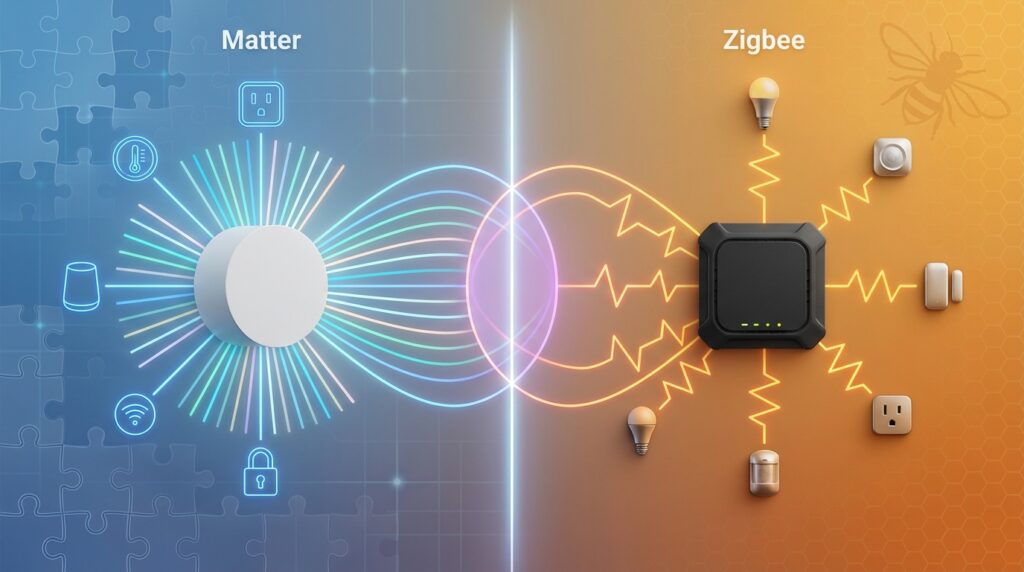
Welcome to the ultimate comparison between two leading smart home technologies. If you’re creating or upgrading your connected living space, you’ve likely encountered these options. Both promise to transform how your household devices communicate and work together.
The newer standard offers universal compatibility across different brands and platforms. It aims to eliminate the frustration of incompatible gadgets. Meanwhile, the established protocol has powered millions of reliable smart home products for over a decade.
The great news is that you might not need to pick just one technology. Many current systems support both standards working together harmoniously. This gives you flexibility and access to a wider range of compatible products.
This guide will walk you through the essential differences and strengths of each approach. We’ll examine how they handle device communication and which scenarios favor one over the other. By the end, you’ll know exactly how to build a smart home that fits your lifestyle in 2026.
Key Takeaways
- Both technologies offer reliable connectivity for your household gadgets
- The newer standard focuses on universal compatibility across brands
- The established protocol has a proven track record of performance
- Many modern systems support both standards working together
- Your choice depends on your existing devices and future plans
- Consider which technology matches your household’s specific needs
- Flexibility is key when building a connected living space
Understanding Smart Home Standards
Before we compare specific standards, let’s explore the fundamental building blocks that enable your smart devices to talk to each other. These communication technologies form the invisible network that makes your home automation work seamlessly.
Defining Key Terms and Protocols
A protocol is essentially the language that devices use to communicate. Think of it like people needing a common language to have a conversation. Different protocols operate at various layers of the communication system.
The OSI model helps us understand how these technologies work together. It breaks communication into seven distinct layers, from physical data transmission to application-level interaction.
Some protocols function as complete solutions handling multiple layers. Others work at specific levels, requiring additional technologies to create a full system. This layered approach explains why different standards have distinct strengths.
The Role of Smart Home Connectivity
Connectivity standards ensure all your devices communicate reliably. Whether lights responding to sensors or thermostats adjusting based on occupancy, the right protocols make everything work together.
These widely used technologies prioritize different goals. Some focus on low power consumption and mesh networking. Others emphasize universal compatibility across brands and platforms.
When building your first smart home setup, understanding these communication layers helps you choose the right system. Effective device communication creates a responsive, reliable smart home that grows with your needs.
Exploring Matter vs Zigbee: A Detailed Comparison
The operational philosophies behind these technologies highlight their unique approaches to device communication. Each standard solves different challenges in the smart home ecosystem.
Key Features and Operational Principles
Zigbee operates as a wireless communication protocol using the IEEE 802.15.4 standard. It excels in low power consumption, making it ideal for battery-operated smart devices.
The mesh networking capability allows Zigbee devices to relay messages, extending coverage throughout your home. Security features include robust AES-128 encryption for all data transmission.
Matter focuses on interoperability rather than replacing existing protocols. It creates a universal layer that works with technologies like Thread and Wi-Fi.
This approach ensures seamless communication between devices from different manufacturers. The simplified setup process uses QR code pairing for quick integration.
Pros and Cons of Each Standard
Zigbee offers proven reliability and a massive selection of affordable products. Its power efficiency extends battery life for sensors and locks significantly.
However, it requires a dedicated hub and has limited direct compatibility with newer standards. Some Zigbee devices only work with specific ecosystems.
Matter provides universal compatibility across major platforms like Apple Home and Google Home. Your investment becomes future-proof with local operation for faster responses.
The growing device ecosystem continues to expand, though bridging is needed for existing non-Matter products. Understanding the underlying protocols adds some complexity.
Technical Breakdown: Protocols, Mesh Networking, and Communication
The magic of a responsive smart home lies in the invisible network architecture that connects your devices. Different protocols use unique methods to route information reliably. Understanding these technical foundations helps you build a stronger, more dependable system.
How Zigbee Operates in a Mesh Network
This established protocol creates a resilient web where each device connects to several others. This structure forms a robust mesh network that automatically finds the best path for data.
Devices have specific jobs in this networking setup:
- Coordinators manage the entire system’s security.
- Routers (like smart plugs) relay messages to extend range.
- End-Devices (like sensors) conserve power by not passing along signals.
Every mains-powered device you add strengthens your whole network. It creates new pathways for communication, reaching every corner of your home.
The Integration of Matter with IP-Based Systems
The newer standard takes a different approach by building on Internet Protocol (IP). It uses familiar systems like Wi-Fi or specialized mesh protocols as its foundation. This allows devices to speak the same language as your home router and internet services.
The integration simplifies setup and enables direct communication. Your gadgets can talk to each other and cloud platforms without complex translation. This IP-based design is key to its cross-platform compatibility vision.
The Emerging Role of Thread in Smart Homes
Thread has become a crucial partner, especially for the new standard. It’s a low-power mesh network protocol designed specifically for connected homes. It combines the reliability of a mesh with the power of IP.
This technology creates a “self-healing” network. If one path is blocked, data automatically finds another route. Thread devices communicate using IPv6, the same protocol that powers the internet.
You need a Thread border router to start, which many modern hubs include. Powered devices then act as extenders, creating a robust web for all your smart gadgets to connect. For a deeper dive into how these technologies compare, explore this guide on smart home protocols.
Interoperability and Ecosystem Support in Smart Home Devices
The true test of any smart home technology comes when you try to mix devices from different brands. This is where interoperability becomes essential for a smooth experience.
Your home’s ecosystem should feel unified, not like separate islands of technology. Major platforms now offer broad support for multiple standards.
Compatibility Across Multiple Brands and Platforms
Modern smart home hubs from Amazon, Apple, Google, and Samsung work with various protocols. This means your devices can communicate across different systems.
When shopping for new products, look for certification that guarantees cross-platform compatibility. This protects your investment in smart home devices.
Many modern Zigbee devices now work with multiple ecosystem platforms. The standardization efforts have significantly improved interoperability.
Seamless Integration with Home Hubs and Controllers
Your central hubs act as translators between different device languages. They create a cohesive system from various home devices.
Platforms like Google Home can now control both newer certified devices and existing ones through bridging. This simplifies your setup dramatically.
The bridging feature allows older Zigbee devices to appear as native compatible products in modern controllers. This means you don’t need to replace working devices.
This integration ensures your smart home devices work together harmoniously. Your hubs provide the necessary support for a truly connected home.
Real-World Performance: Security, Range, and Power Efficiency
Let’s examine how these technologies perform where it counts most: in your daily home environment. The true value emerges through consistent operation and practical benefits.
Network Stability and Mesh Performance Analysis
Security remains paramount for any connected home. Both standards employ robust encryption to protect your data. The established protocol uses AES-128 encryption across all transmissions.
Mesh networking delivers impressive range coverage. Each powered device extends your network reach automatically. This creates a self-healing web that maintains connection even if one path fails.
Your home’s Wi-Fi congestion doesn’t affect this dedicated system. It operates independently, ensuring stable performance during heavy internet use. This separation provides reliable operation when you need it most.
Evaluating Power Consumption and Device Longevity
Battery life becomes crucial for wireless sensors and smart locks. The low power requirements of certain zigbee devices enable exceptional longevity. Many homeowners report years of service from single batteries.
Motion detectors and contact sensors demonstrate this efficiency perfectly. They conserve power by sleeping between activations. This intelligent design saves you time and maintenance costs.
Real-world testing confirms impressive device durability over time. Many zigbee devices continue functioning flawlessly after several years. This proven track record gives confidence in your smart devices investment.
The 2.4 GHz frequency occasionally faces interference challenges. However, advanced channel-hopping capabilities manage this automatically. Your network adapts without requiring manual intervention.
Future-Proofing Your Home: Innovations and Growth in Smart Standards
Looking ahead to 2026 and beyond, the smart home landscape continues to transform through collaborative innovation. Choosing the right foundation ensures your investment remains valuable for years to come.
The industry’s commitment to universal standards represents a significant shift. The Connectivity Standards Alliance, which evolved from earlier organizations, now drives this unified approach forward.
Upcoming Advances in Matter and Zigbee Technologies
The open-source development kit makes certification dramatically easier for manufacturers. This means we’ll see an explosion of compatible products hitting the market.
Thread has become increasingly popular as a primary underlying protocol. Major manufacturers are releasing Thread-enabled devices that work seamlessly across platforms.
The established technology maintains its strong market presence with proven reliability. Both standards serve important but different purposes in modern homes.
Flexibility and Adaptation in Evolving Smart Ecosystems
Modern systems allow you to build with existing devices while adding new compatible products. Bridging technology creates harmony between different protocols.
The smartest approach involves choosing controllers that support multiple standards. This ensures you’re never locked into a single technology path.
Home automation evolves rapidly, so gradual adoption makes more sense than complete replacement. Future innovations will expand device categories and improve integration.
Conclusion
The journey through smart home standards reveals that flexibility, not exclusivity, is the key to success. Both technologies offer unique advantages that complement each other perfectly in modern home automation.
For building smart home systems in 2026, start with a hub that supports multiple protocols. This approach gives you the freedom to choose the best devices for each application. Your existing equipment continues working reliably while new additions bring enhanced compatibility.
The real victory comes from blending proven reliability with future-ready innovation. Focus on quality smart home devices from reputable manufacturers. As you explore options, this comprehensive guide helps understand how different standards work together.
Whether you’re starting fresh or expanding your current setup, the strategy remains the same. Choose a flexible foundation that grows with your needs. Learn more about future-proof home automation to make informed decisions for your connected living space.