
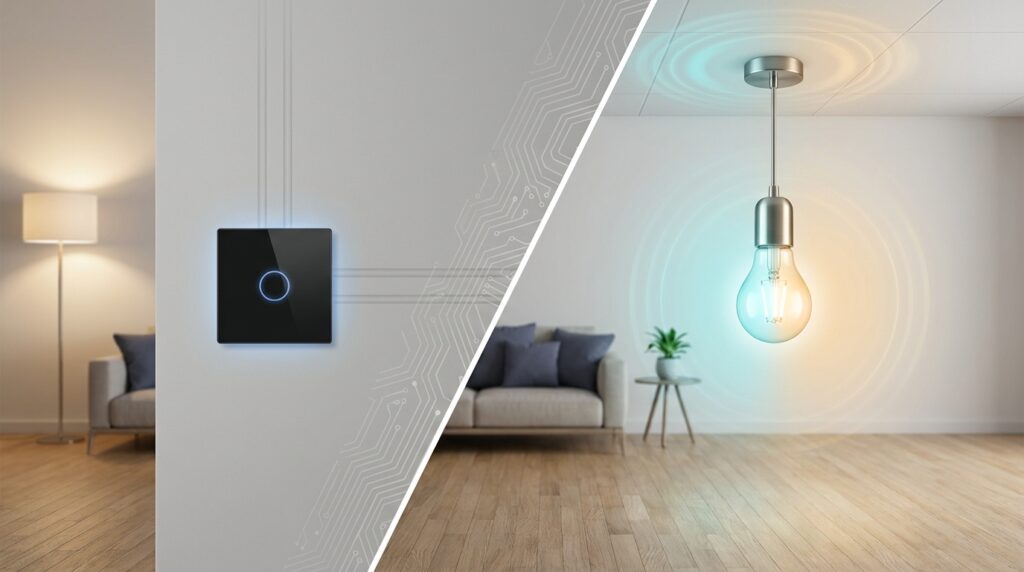
Welcome to your complete guide for modernizing your home’s illumination system. Many homeowners face an important decision when upgrading their living spaces. Should you replace traditional wall controls or install intelligent bulbs instead?
This comprehensive comparison will help you navigate this exciting choice. We’ll explore practical differences between these two approaches. You’ll learn about cost considerations, installation requirements, and long-term benefits.
By the end of this article, you’ll understand the key advantages of each technology. We’ll help you determine which solution aligns best with your specific needs. The right choice depends on factors like your home’s wiring, budget, and desired features.
This friendly guide is designed for homeowners at any technical level. Whether you’re beginning your automation journey or expanding an existing system, we’ve got you covered.
Key Takeaways
- Understand the fundamental differences between wall-mounted controls and bulb-based solutions
- Learn how your home’s existing wiring affects which option works best
- Discover the cost implications of each approach for different room setups
- Evaluate installation complexity based on your DIY comfort level
- Consider how extensively you want to automate your living spaces
- Identify which features matter most for your daily routine and convenience
- Make an informed decision that aligns with your budget and technical preferences
Introduction to Smart Lighting Upgrades
Many homeowners overlook their illumination systems as potential candidates for modernization. Yet this represents one of the most transformative upgrades available today. Traditional wall controls have served us faithfully for generations.
These everyday devices blend into our homes like familiar furniture. But new technology brings remarkable capabilities to these simple interfaces.
Setting the Stage for Modern Home Automation
Contemporary home automation has reshaped how we interact with our living spaces. Lighting serves as an ideal starting point for this journey. It offers immediate benefits with relatively simple installation.
Upgraded systems allow voice commands or app-based management from anywhere. You can adjust settings while at work or even traveling. This flexibility transforms basic functionality into personalized experiences.
Why Upgrading Your Lighting Matters
Modernizing your illumination directly impacts daily comfort and energy efficiency. These systems provide enhanced security through realistic occupancy patterns. They also offer significant convenience improvements.
Imagine never searching for a control in darkness. Consider turning off forgotten fixtures remotely. These small changes collectively improve quality of life.
| Upgrade Aspect | Traditional System | Modern Solution | Key Benefit |
|---|---|---|---|
| Control Method | Manual wall operation | Voice, app, automated | Remote access |
| Energy Management | Basic on/off function | Scheduling & monitoring | Cost savings |
| Security Features | Manual operation only | Automated patterns | Deterrence capability |
| Integration Potential | Standalone operation | Whole-home ecosystem | Expanded functionality |
The right upgrade path depends on your specific needs and existing infrastructure. Both approaches offer distinct advantages for different situations.
Understanding Smart Light Switches: Features, Benefits, and Capabilities
Modern wall-mounted devices offer sophisticated control over your home’s lighting without requiring bulb replacements. These intelligent solutions transform how you manage illumination throughout your living spaces.
Key Features of Advanced Wall Controls
Today’s advanced controls provide direct Wi-Fi connectivity for seamless integration. Models like the TP-Link Kasa KS225 include intuitive three-button layouts for dimming and on/off functions.
The accompanying applications enable comprehensive automation through scheduling and group management. You can create custom routines based on time of day or sunrise/sunset patterns.
Advanced capabilities include energy monitoring and Away mode for security. These features deliver both convenience and peace of mind when traveling.
Compatibility and Installation Requirements
Installation involves replacing existing wall controls and requires basic electrical knowledge. The process is straightforward for those comfortable with DIY projects.
Compatibility varies by model, with some devices needing a neutral wire in the electrical box. This is common in newer homes, while older homes may require neutral-wire-free options.
These solutions work with any bulb type—LED, CFL, incandescent, or halogen. This flexibility means you don’t need to replace functioning bulbs throughout your home.
Comparing Smart Light Switches and Smart Bulbs
The debate between upgrading your wall controls versus individual bulbs presents distinct advantages for different household needs. Each approach serves specific situations better than the other.
Pros and Cons of Each Approach
Wall-mounted upgrades control illumination at the source. They work with any existing bulbs, making them cost-effective for whole-room implementations. A single device can manage multiple fixtures on one circuit.
These devices function like traditional controls. Family members and guests can operate them manually without smartphones. This prevents the common problem of someone turning off the physical switch and disabling automation.
Bulb-based systems excel in specific scenarios. Renters who cannot modify electrical systems benefit from this approach. They’re ideal for adding color-changing capabilities or managing lamps where switch replacement isn’t practical.
A critical warning: never pair intelligent bulbs with smart dimmers. Most combinations aren’t compatible and cause flickering, flashing, or buzzing. This can damage both devices over time.
Cost comparisons reveal interesting patterns. Individual bulbs may seem cheaper initially. However, upgrading multiple bulbs per room often costs more than installing one wall control that manages all lights on that circuit.
The most practical solution for many homes involves a hybrid approach. Use wall controls for general room illumination. Reserve bulb upgrades for accent lighting, lamps, or situations requiring color control.
Evaluating Lighting Control and Automation Options
Modern lighting control systems offer far more than simple on/off functionality. Today’s automation capabilities transform how you interact with your home’s illumination throughout the day.
Basic scheduling represents the foundation of automated control. You can program exterior lights to activate at sunset or dim bedroom fixtures at bedtime. This creates consistent routines without daily manual adjustments.
Scene creation takes automation to the next level. Imagine activating a “Movie Night” setting that dims living room illumination while turning off other lights. These presets save specific configurations across multiple rooms for instant recall.
Wireless scene controllers provide physical access to your favorite settings. They mount on any wall without additional wiring. These devices offer one-touch control of up to four user-configured scenes.
Home/Away automation enhances security while you travel. The system cycles lights on and off to simulate normal occupancy patterns. This creates a lived-in appearance that deters potential intruders.
Remote control capabilities let you manage your home from anywhere. Adjust settings while at work or on vacation through smartphone apps. This flexibility ensures your space always meets your needs.
Advanced options include geofencing that responds to your arrival home. Voice commands through smart assistants add hands-free convenience. Motion sensors provide automatic operation in high-traffic areas like hallways.
Sunrise/sunset scheduling automatically adapts throughout the year. The system adjusts timers as daylight hours change with the seasons. This eliminates manual updates while maintaining optimal illumination patterns.
Overcoming Common Installation Challenges and Wiring Considerations
Installing advanced lighting controls often presents unique challenges that homeowners should understand before starting their project. Proper preparation ensures a smooth installation process and prevents common pitfalls.
Knowing what to expect helps you gather the right tools and materials. It also helps you decide whether to tackle the project yourself or hire professional assistance.
Tips for Handling Neutral Wire Issues
The neutral wire requirement represents the most common installation challenge. Many modern devices need this white wire to power their internal circuitry.
Older homes built before the 1980s often lack neutral wires in switch boxes. Before purchasing any device, open your existing box and identify the wires present.
If you see only black and red wires without a white neutral wire, you’ll need a no-neutral-compatible model. The Leviton Decora Smart No-Neutral Dimmer DN6HD addresses this limitation specifically.
This affordable solution communicates wirelessly with a plug-in Decora Smart Wi-Fi Bridge. The system allows mixing up to 25 devices throughout your home without neutral wire connections.
DIY Versus Professional Installation
DIY installation works for homeowners comfortable with basic electrical work. You’ll need standard tools like screwdrivers, wire strippers, and voltage testers.
Always shut off power at the breaker before beginning any electrical work. Confirm your switch box has adequate depth since these devices tend to be bulkier than traditional models.
Professional installation makes sense in several situations. Consider hiring an electrician if you’re uncomfortable working with wiring or have complex three-way switch configurations.
Unexpected wiring scenarios or crowded boxes also warrant professional help. They can ensure proper installation and address any safety concerns.
- Box Space Check: Modern devices require more space than traditional models
- Wire Identification: Always verify existing wiring before purchase
- Safety First: Never work on live electrical systems
- Three-Way Setup: Requires special compatible devices or companion switches
Top Smart Lighting Solutions and Product Recommendations
Choosing the right products for your home automation journey can feel overwhelming with so many options available. We’ve tested numerous devices to identify the best performers across different categories and price points.
Our recommendations consider ease of use, reliability, and platform compatibility. These factors ensure your investment works seamlessly with your existing ecosystem.
Highlighting Leading Brands and Models
The TP-Link Kasa KS225 Matter Smart Wi-Fi Dimmer stands out as our top pick. This device offers excellent value and works with every major platform including Amazon Alexa and Google Home.
For situations where dimming isn’t needed, the TP-Link Kasa KS205 provides similar reliability at a lower cost. It’s perfect for bathrooms and closets with non-dimmable fixtures.
The Feit Electric Smart Wi-Fi Dimmer serves as a reliable alternative with broad platform support. Meanwhile, the Leviton Decora Smart Z-Wave Dimmer ZW6HD excels for homeowners with existing Z-Wave systems.
Shelly offers compact, affordable devices starting at just $17.49. Their product line includes specialized solutions for comprehensive whole-home automation.
Legrand’s radiant and adorne collections provide premium options with elegant designs. These devices integrate Wi-Fi and Netatmo connectivity for advanced capabilities.
| Product | Best For | Key Feature | Price Range |
|---|---|---|---|
| TP-Link Kasa KS225 | Overall value | Matter compatibility | Mid-range |
| Feit Electric Dimmer | Budget-conscious | Broad platform support | Affordable |
| Leviton ZW6HD | Z-Wave systems | Extensive customization | Premium |
| Shelly devices | Multi-protocol needs | Compact design | Budget to mid-range |
| Legrand collections | Premium aesthetics | Design integration | High-end |
Integration with Popular Smart Home Platforms
Platform compatibility significantly impacts your experience. Matter-enabled devices like newer TP-Link models ensure the broadest compatibility.
This future-proofs your investment as Matter becomes the universal smart home standard. Always verify that your chosen device works with your preferred assistants and hubs.
Consider your existing network and whether you need hub-based or direct Wi-Fi connectivity. Each approach offers distinct advantages for different home setups.
Exploring the Benefits of Integrated Smart Home Ecosystems
The true power of home automation emerges when individual components communicate and coordinate their functions. This creates a cohesive environment where various systems work together seamlessly.
Enhancing Home Security and Energy Efficiency
Integrated ecosystems significantly boost your home’s security. Advanced wall controls feature Away modes that create realistic occupancy patterns. These systems randomly activate lights to deter potential intruders while you’re traveling.
Energy efficiency improves dramatically with connected devices. Built-in energy meters provide precise consumption data with 1% accuracy. This helps identify wasteful habits and optimize electricity usage.
The same network infrastructure can manage heating, cooling, and various appliances. This creates comprehensive automation scenarios across your entire home. LED technology pairs perfectly with these systems for maximum savings.
Sophisticated rules enable lights to activate when motion sensors detect activity. Your thermostat can trigger lighting adjustments based on occupancy modes. This coordination transforms basic control into intelligent home management.
Key Considerations for Your Smart Lighting Purchase
When upgrading your electrical controls, balancing initial costs with future value is essential for making wise purchasing decisions. The market offers options from budget-friendly to premium models, each with distinct advantages.
Budgeting and Long-Term Value
Price ranges for these devices vary significantly. Economical choices like Shelly compact models start around $17.49, while professional-grade solutions can exceed $120. The TP-Link Kasa line represents excellent mid-range value.
Their plug-in units begin at $17.76, with standard wall controls around $44.79. Full-featured dimmers cost approximately $48.43. Premium brands like Legrand command $44.75 to $121.18 but offer superior build quality.
Starter kits bundling gateways with switches provide better value than separate purchases. This is particularly true for systems requiring hubs. Consider how many units you’ll ultimately need throughout your home.
Long-term value extends beyond purchase price. Energy savings from usage monitoring and reduced bulb replacement costs through dimming contribute to overall value. The convenience of automation saves daily time.
Functionality should match your actual needs. Don’t overpay for features you won’t use. Ensure your chosen solution supports essential capabilities like voice control and scheduling.
Factor in potential installation costs if hiring professionals. These typically range $50-$150 per switch depending on complexity. For comprehensive guidance on alternative approaches, explore this detailed comparison of lighting options.
How Smart Switches Improve Daily Living
The true measure of any home upgrade lies in how seamlessly it integrates into your daily routine. Modern electrical controls transform ordinary moments by eliminating common frustrations.
Convenience and Remote Control Benefits
Daily convenience begins with eliminating those dark fumbling moments. Voice-activated systems let you illuminate spaces hands-free when entering rooms.
Remote access capabilities provide peace of mind from anywhere. Never wonder again if you left garage lights on while at work. A quick phone check gives answers and control.
The ability to manage one fixture or entire home lighting through a single app transforms your interaction with living spaces. Whole-house adjustments become as simple as tapping your screen.
- Voice integration works with Alexa, Google Assistant, or Siri for adjustments during activities
- Automated routines brighten bedrooms gradually for natural wake-ups
- Occupancy sensing turns illumination on when entering and off after leaving
- Scene configurations create one-touch settings for common situations
These small conveniences collectively reduce daily friction. You gain more time to focus on what truly matters rather than mundane switch operations.
Future Trends in Smart Lighting Technology
What lies ahead for automated illumination represents some of the most exciting developments in home technology. The industry is moving toward more intuitive, interconnected systems that work seamlessly together.
Universal standards like Matter are transforming how devices communicate. This breakthrough ensures products from different manufacturers work together effortlessly.
The Evolution of Home Automation
Home automation continues advancing toward greater simplicity and intelligence. Early systems required complex programming and proprietary hubs.
Today’s approach focuses on plug-and-play installation with multiprotocol support. Next-generation controls will handle Wi-Fi, Zigbee, Matter, and Bluetooth simultaneously.
Z-Wave Long Range technology extends coverage across larger properties. This reduces the need for additional network extenders while improving reliability.
Upcoming Innovations in Lighting Control
Artificial intelligence will revolutionize how lighting systems operate. Instead of manual programming, they’ll learn household patterns automatically.
Enhanced energy monitoring will identify specific appliances by their electrical signatures. This provides personalized recommendations for reducing consumption.
The Thread networking protocol creates robust mesh networks designed for home automation. It offers lower power use and faster response times than current solutions.
Advanced sensors will expand beyond motion detection to include ambient light sensing and health monitoring. Future systems may adjust illumination to support natural circadian rhythms.
Improved interoperability means lighting will work effortlessly across all major platforms. You won’t need separate apps or complicated configuration processes.
Expert Tips for Maximizing Your Smart Lighting System Performance
Custom scenes and schedules transform basic automation into a truly personalized home experience. These features unlock the full potential of your investment by creating seamless daily routines.
Creating Customized Scenes and Schedules
Start with essential daily patterns like “Wake Up” and “Bedtime” routines. Gradually brightening bedroom illumination creates natural wake-ups. Systematic dimming helps wind down for sleep.
Wireless options expand your control without additional wiring. Battery-operated units pair with existing setups. They create convenient three-way configurations anywhere.
Easy installation kits bundle wired and wireless components. These simplify multi-location control setups. They communicate without traditional traveler wires.
Scene controllers provide touch access to four preset configurations. Mount them in central locations for household convenience. Everyone can access common settings easily.
When beginning your automation journey, consider bundled packages. Starter kits include bridges and devices at reduced costs. They ensure compatibility and better value.
For comprehensive guidance on controlling lights effectively, explore detailed resources. LED compatibility matters for dimmer performance. Select bulbs specifically tested for your devices.
Direct Wi-Fi connections simplify setup and improve responsiveness. This approach reduces potential failure points in your system.
Conclusion
Making the final decision about your home’s illumination system requires balancing practical considerations with future goals. Your choice ultimately depends on your specific living situation and automation ambitions.
Wall-mounted upgrades typically offer better long-term value for permanent installations. They work with any bulb type and provide intuitive operation for all household members. Consider your home’s wiring, particularly neutral wire requirements, when selecting products.
From budget-friendly options to premium collections, the market offers solutions for every need. The TP-Link Kasa KS225 represents an excellent balance of affordability and features. Matter-enabled devices ensure future compatibility as technology evolves.
Begin with starter kits in high-traffic areas to experience the convenience firsthand. Thoughtful scene creation and strategic placement maximize results. Whether choosing Z-Wave or Wi-Fi models, the right solution transforms daily living through enhanced control and automation capabilities.