
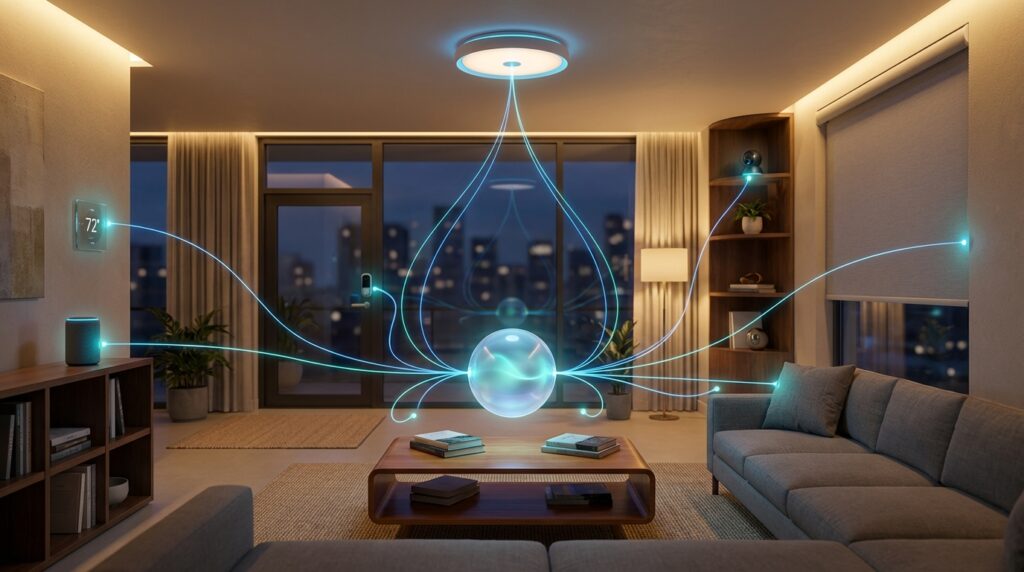
Welcome to a fresh look at the smart home’s future. We’re exploring what’s next for this exciting technology. The landscape is changing fast, and a new standard is leading the way.
This universal standard unites major players in the industry. It promises a world where all your gadgets work together seamlessly. This is a fundamental shift in how our homes operate.
Understanding this development is key for everyone. Consumers, creators, and companies all benefit. It’s about building smarter, more connected ecosystems for everyone.
This article will guide you through the upcoming features and devices. We’ll break down the pipeline of innovation you can expect to see. Our goal is to make these complex ideas easy and exciting to understand.
This isn’t just a small step forward. It’s a leap toward a more intuitive and powerful smart home experience. The possibilities are expanding right now.
Key Takeaways
- Matter is a universal standard creating seamless compatibility between smart home products.
- This technology brings together major brands to improve your daily life.
- New types of devices, like major appliances and energy managers, are joining the ecosystem.
- The development focus is on local control, enhancing reliability and privacy.
- Regular updates ensure the standard evolves with new features and capabilities.
- This innovation simplifies setup and use for a better user experience.
Introduction to the Matter Roadmap
A new era of home automation is emerging through unprecedented industry cooperation. This strategic framework represents a solution to long-standing interoperability challenges. Major technology leaders have united to create a universal standard.
The Connectivity Standards Alliance (CSA) coordinates this important development. Companies like Apple, Google, Amazon, and Samsung contribute to this open-source project. Their collaboration ensures smart home systems work together seamlessly.
This living document outlines planned enhancements and new device categories. It functions as a dynamic guide for smart home evolution. The roadmap rolls out in carefully planned phases.
| Roadmap Phase | Focus Area | Key Benefits |
|---|---|---|
| Current Implementation | Core device compatibility | Basic interoperability between systems |
| Near-term Expansion | New device categories | Broader ecosystem integration |
| Future Development | Advanced features | Enhanced performance and reliability |
The approach includes both horizontal expansion and vertical deepening. More device types join the ecosystem while existing categories gain richer features. This dual strategy strengthens entire smart home systems.
Following this framework helps stakeholders anticipate market changes. Companies can plan product cycles effectively. Consumers make informed decisions about their smart home investments.
Overview of the Smart Home Revolution
Over the past decade, our homes have quietly transformed from static structures into dynamic, responsive environments. What started with simple programmable thermostats has exploded into complex ecosystems of interconnected devices. This evolution represents one of the most significant technological changes in modern living.
The smart home market faced a major challenge during these growth years. Thousands of manufacturers created incompatible systems using different wireless standards. Consumers struggled with devices that couldn’t communicate with each other, limiting the true potential of home automation.
People’s expectations have shifted dramatically. Early adopters accepted managing multiple apps and platforms. Today’s consumers demand seamless integration across all their smart home systems. They want their devices to work together effortlessly.
Several technological advances converged to make this transition possible. Improvements in wireless communication, cloud computing, and artificial intelligence created the foundation for truly intelligent homes. This innovation enables devices throughout the world to coordinate more effectively.
The market has matured from niche early adopters to mainstream consumers. This shift drives the need for reliable, standardized smart home systems. The current moment represents a pivotal point where fragmented development gives way to unified solutions that benefit everyone.
The Role of Matter in Enhancing Device Interoperability
Imagine a world where your smart lights, thermostat, and security system all speak the same language. This is the promise that Matter delivers by solving the compatibility puzzle that has frustrated smart home users for years.
The standard acts as a universal translator between different devices. It uses standardized communication protocols and unified data models. This common framework allows products from various brands to understand each other perfectly.
One of the key benefits is dramatically simpler setup processes. Users gain intuitive access to features across their entire smart home ecosystem. The design ensures reliable performance without complex configurations.
Rather than replacing existing technologies, Matter works alongside Wi-Fi, Thread, and Bluetooth. It provides a unifying layer that leverages your current infrastructure. This approach delivers interoperability while maintaining what already works well.
Picture arriving home to lights that automatically brighten when your smart lock detects your presence. This seamless coordination between different systems creates a more cohesive living environment. The core advantage is effortless control over your entire smart home.
Trends in Active Matter and Complex Systems
What if your smart home could organize itself like a flock of birds or a school of fish? This fascinating concept comes from studying active matter—systems where individual elements follow simple rules to create complex collective behaviors.
Researchers examine everything from microscopic swimmers to animal groups. They discover patterns that could transform how technology coordinates itself.
Exploring Bio-Inspired Collective Behaviors
Nature provides incredible examples of self-organization. Flocking birds and swarming insects demonstrate emergent properties that researchers are now understanding.
These biological systems operate without central control. Each agent responds to local cues from its environment. This creates robust, adaptive coordination.
The same principles could help smart home devices work together more intelligently. They might automatically adjust to changing conditions in your living space.
Applications in Synthetic Active Materials
Scientists are creating new materials that mimic nature’s self-organizing abilities. These synthetic active materials can respond and adapt to their surroundings.
Future smart home applications might include walls that regulate temperature or surfaces that clean themselves. The development of such responsive materials presents exciting challenges.
Researchers gain valuable insights into managing complex systems. These discoveries could lead to homes that anticipate and respond to our needs more naturally.
Electric Mobility Meets Intelligence: AI-Defined Vehicles
Intelligence is becoming the central nervous system of next-generation vehicles. Ahmedabad-based electric mobility firm MATTER recently unveiled the country’s first AI-Defined Vehicles platform. This marks a structural shift in how electric two-wheelers are designed and engineered.
The company positions intelligence as the core layer of future transportation. This represents a bold move beyond software-defined vehicles toward truly intelligent mobility.
MATTER’s Role in Electric Two-Wheelers
MATTER’s approach integrates artificial intelligence directly into vehicle architecture. The AIDV platform allows intelligence to govern multiple systems in real time. This includes materials selection, energy management, and thermal control.
The company has outlined an ambitious five-segment expansion plan. This covers diverse categories from adventure motorcycles to youth-focused commuters. Each vehicle benefits from the same intelligent foundation.
Innovative Vehicle Architectures and Software Updates
Unlike traditional architectures, AI-defined vehicles continuously evolve. They offer predictive reliability and adaptive ride behavior throughout their lifecycle. Software updates enable ongoing capability expansion without hardware changes.
MATTER’s development journey began with their AERA platform. This introduced industry-first features like the Hypershift gearbox. The evolution to AIDV represents significant innovation in control systems.
| Vehicle Category | Key Intelligent Features | Update Capabilities |
|---|---|---|
| Naked Street Motorcycles | Adaptive power delivery | Ride behavior optimization |
| Adventure Models | Predictive terrain response | Safety enhancement updates |
| Electric Scooters | Intelligent energy management | Range optimization software |
This technology demonstrates how intelligence-driven design principles are transforming multiple industries. The parallel with smart home evolution shows a broader trend toward adaptive, learning systems.
Examining the Matter Roadmap
Understanding the phased approach to smart home standardization reveals a carefully orchestrated development process. The Matter initiative organizes its growth into clear stages, ensuring each new capability builds on a stable foundation.
Currently, core device categories like lighting, thermostats, and smart plugs are fully supported. These foundational systems demonstrate the protocol’s reliability in real-world homes today.
The near-term roadmap focuses on expanding compatibility over the next 12-24 months. Expect to see more sophisticated devices joining the ecosystem with enhanced automation features.
Looking 2-3 years ahead, the vision includes deeper integration between different smart home systems. This medium-term development will enable more complex interactions and predictive capabilities.
The Connectivity Standards Alliance manages this progression through dedicated working groups. They balance innovation with stability, ensuring new Matter capabilities maintain backward compatibility.
This structured approach helps consumers make informed decisions about their smart home investments. The careful development timeline prevents market fragmentation while advancing entire systems forward together.
Roadmap for Next-Generation Smart Devices
The next wave of smart home evolution brings exciting developments in device interoperability. New categories are joining the unified ecosystem, making homes smarter than ever before.
Enhanced camera support, robotic assistants, and advanced appliances are on the near-term horizon. These additions will work seamlessly with your existing smart home systems.
Improved Connectivity and Integrated Control
Future devices will feature more robust network handling and multi-protocol support. This means your smart home systems will maintain connections even during network changes.
Integrated control becomes more sophisticated with these connectivity improvements. You’ll enjoy complex automation scenarios through intuitive interfaces.
The design focuses on making advanced features accessible to everyone. Simple setup processes mask the powerful technology working behind the scenes.
Enhanced Security and Compliance Features
Security receives significant upgrades with stronger encryption and authentication mechanisms. These features protect against emerging cyber threats while maintaining ease of use.
The architecture includes built-in compliance capabilities that adapt to regulatory changes. This future-proofs your investment without requiring hardware updates.
These improvements work together to create trustworthy, capable smart home systems. Better connectivity enables sophisticated control, while enhanced security ensures peace of mind.
Integrating Matter in Home Automation
The true power of a smart home is realized when all its components work in harmony. This seamless integration is now becoming a reality for many homeowners. The adoption of unified standards is transforming complex setups into intuitive, cohesive systems.
Unified Standards Across Diverse Devices
Imagine your lights, thermostat, and door locks all understanding each other perfectly. This is the core promise of a unified design. It allows different brands and categories of devices to communicate effortlessly.
This approach simplifies the entire user experience. You gain flexible control over your environment without being locked into a single brand’s ecosystem. The systems are designed for reliability and ease of use from the start.
Real-World Implementation and User Experience
In practical applications, this means a single app can manage your entire home. Whether you prefer Apple Home, Google Home, or another platform, your choice of interface is yours. This flexibility is a key benefit of the standard.
Security systems demonstrate this integration beautifully. Cameras, motion sensors, and smart locks can now work together. They create a comprehensive security net that is both powerful and simple to manage.
For a deeper dive into how this technology works, check out our complete guide to the Matter protocol.
The overall experience is one of simplified control and greater reliability. Homeowners are reporting fewer connectivity issues and a more responsive smart home environment. This practical success marks a significant step forward for home automation.
Emerging Trends in AI and Material Design for Smart Devices
Artificial intelligence is now helping create the very materials that make up our smart devices. This exciting development represents a major leap forward in how we think about home technology.
Scientists are using machine learning to design new materials with specific properties. These advanced substances can conduct electricity better or last longer than traditional options.
AI-Driven Material Innovation
The innovation doesn’t stop at creation. Some materials can now sense changes in their environment. They adjust their properties automatically without complex control systems.
Imagine walls that regulate temperature or surfaces that clean themselves. This smart design approach makes devices more responsive to our needs.
Adaptive Control Systems and Predictive Performance
AI also helps devices learn our preferences over time. Your thermostat might notice when you usually adjust the temperature. It can then make these changes automatically.
Lighting systems can adapt to your circadian rhythms. Security cameras can distinguish between normal activity and potential threats.
This predictive capability creates homes that anticipate our needs. The technology works behind the scenes to make life simpler and more comfortable.
These advances build on standardized communication between devices. They represent the next step in creating truly intelligent living spaces.
Challenges and Opportunities in the Matter Ecosystem
Building a unified smart home standard presents both exciting possibilities and significant hurdles. The transition to universal compatibility involves careful navigation of technical and regulatory landscapes.
Regulatory and Compliance Considerations
European regulations like GDPR, NIS2, and the Cyber Resilience Act create important compliance challenges. These rules ensure data protection and cybersecurity across connected systems.
Manufacturers must adapt their development processes to meet different regional requirements. This standardization effort requires balancing innovation with legal obligations.
Market Expansion and Competitive Advantages
The Matter ecosystem lowers barriers for smaller companies to enter the smart home market. They can focus on device innovation rather than building proprietary systems.
Early adopters gain competitive advantages through broader integration partnerships. This industry-wide cooperation creates new opportunities for growth and consumer trust.
Technical challenges include supporting legacy protocols during the transition period. Managing firmware updates across diverse device populations requires careful planning.
Innovations in Software and Hardware for Next-Gen Devices
Today’s smart devices are undergoing a quiet revolution in how they’re built and how they operate. This transformation spans both software improvements and hardware design breakthroughs.
On the software side, sophisticated operating systems now enable richer user experiences. Improved development frameworks make it easier to build support for unified standards. Advanced application layers provide more intuitive control over device functions.
Hardware innovation brings equally exciting changes. New system-on-chip designs integrate multiple wireless protocols seamlessly. Enhanced sensors deliver richer environmental data to smart home systems. Energy-efficient components extend battery life significantly.
The real magic happens when software and hardware work together through co-design. This approach creates devices that are more capable yet simpler to use. Better performance and lower costs result from this coordinated development.
Modular device architecture allows for easier upgrades and repairs. Edge computing processes data locally for faster response times. Over-the-air updates let devices gain new functions throughout their lifespan.
These technical improvements translate to practical benefits you’ll notice daily. Expect faster response times, longer battery life, and devices that actually improve with age. Your smart home systems will work more reliably than ever before.
A Closer Look at Nexus and PKI Services in Matter Compliance
Security forms the invisible backbone of every trustworthy smart home system. Nexus plays a critical role as a Public Key Infrastructure provider for the Matter framework. This ensures each device’s identity is verified before joining your home network.
Ensuring Device Security and Trust
Think of PKI like a digital passport system for smart devices. Nexus acts as an independent Product Attestation Authority that audits and certifies manufacturers. They issue Device Attestation Certificates that become part of every compliant device.
This process guarantees authenticity before devices gain access to your smart home systems. Each certificate provides proof that the device meets strict security standards. This creates a foundation of trust at the core of the Matter ecosystem.
Advantages of a Vendor-Independent Approach
Nexus’s neutral position offers significant benefits for manufacturers and consumers alike. Companies maintain control over their certification process without being locked into proprietary systems. This vendor-independent approach ensures fair access to Matter certification worldwide.
| Certification Approach | Traditional Vendor-Locked | Nexus Independent Model |
|---|---|---|
| Manufacturer Flexibility | Limited to single ecosystem | Works across all platforms |
| Consumer Choice | Restricted compatibility | Broad device interoperability |
| Security Verification | Proprietary standards | Consistent Matter compliance |
As a European company, Nexus operates data centers within Europe for enhanced compliance with regulations like GDPR. Their connection to French government-owned IN Groupe provides additional oversight. This combination delivers robust security while maintaining the open nature of the Matter standard.
Cross-Industry Collaboration and Future Developments
History shows that when industry rivals unite around a common goal, innovation accelerates dramatically. This principle is now transforming smart home technology through unprecedented partnerships.
Strategic Tech Partnerships
Traditional competitors like Apple, Google, Amazon, and Samsung have recognized that collaboration serves everyone better than fragmented ecosystems. Their joint effort creates a foundation where all devices work together seamlessly.
The Connectivity Standards Alliance provides neutral ground for this cooperation. Hundreds of companies contribute to specifications and development as part of this growing ecosystem.
Adoption of Universal Standards
This initiative differs from past standardization attempts because market leaders have made genuine commitments. They’re backing the standard with resources that drive widespread adoption across the industry.
Smaller manufacturers benefit significantly from this approach. They can focus on device innovation without building entire proprietary systems from scratch.
Future developments emerging from this collaborative model include expanded device categories and enhanced capabilities. These advancements wouldn’t be possible in competitive, proprietary environments.
The result is accelerated technology development that moves from concept to implementation faster than ever before. This cooperation creates a more accessible and user-friendly market for everyone involved.
Impact on Consumer Experience and Smart Living
The real test of any smart home technology is how it improves your daily routine. This unified approach transforms complex setups into intuitive systems that enhance your quality of life. The focus shifts from technical specifications to tangible benefits you experience every day.
User-Centric Design and Seamless Integration
Imagine buying any smart device without compatibility worries. This freedom revolutionizes your shopping experience. You choose products based on features and design, not ecosystem locks.
Setting up new devices becomes remarkably simple. The frustration of multiple apps and complex configurations disappears. Your smart living space works together seamlessly from day one.
| Before Standardization | With Unified Systems | Daily Life Impact |
|---|---|---|
| Multiple apps required | Single control interface | Simplified management |
| Compatibility confusion | Any device works together | Stress-free shopping |
| Complex setup processes | Quick installation | More time enjoying |
Your home environment responds intelligently to your needs. Lights adjust automatically when you arrive. Temperature settings follow your preferences without constant manual control.
Guests can operate things easily without downloading special apps. Replacing devices doesn’t mean reconfiguring your entire system. This convenience makes smart living accessible to everyone.
The true measure of success is how technology enhances your daily experience. When systems work reliably behind the scenes, you focus on living better rather than managing technology.
Future Outlook and Emerging Applications
The next chapter in smart technology development reveals a world where our living spaces become active partners in our daily routines. This evolution promises exciting new applications that will transform how we interact with our environments.
Long-Term Industry Trends
Over the coming years, we’ll see smart home systems merge with broader infrastructure. Buildings and cities will share intelligent layers of communication. This convergence creates powerful networks that optimize energy use and enhance safety.
Research into collective behavior provides valuable insights for these complex systems. Understanding how elements coordinate helps design more efficient smart environments.
Potential Breakthroughs and Predictive Reliability
Advanced AI integration represents one of the most promising developments. Future systems will anticipate needs before they arise. Your home might adjust lighting and temperature based on your patterns.
Predictive reliability ensures everything works seamlessly. These applications learn and adapt to your lifestyle, creating truly personalized spaces.
Shaping a Smarter Tomorrow
Emerging applications extend beyond traditional devices. Health monitoring systems could track wellness indicators. Environmental sensors might optimize air quality automatically.
Smart materials with adaptive properties will create responsive surfaces. These changes could dramatically improve daily life for everyone, especially elderly populations.
The foundation layer of interoperability enables these advanced applications. This sets the stage for a smarter, more connected world.
Conclusion
The collaborative spirit driving today’s smart home innovation marks a turning point for connected living. Our journey through the matter roadmap reveals how universal standards transform complex systems into intuitive experiences.
This technology delivers practical benefits you’ll notice every day. You gain simplified control over your home environment with enhanced security. The freedom to choose devices based on merit replaces ecosystem lock-in.
While challenges remain in this transition, the opportunities outweigh them. Cross-industry collaboration ensures the standard evolves to meet changing needs.
Beyond individual homes, these applications support sustainable energy management and accessibility. The foundation is set for smarter buildings and cities.
This evolution makes smart living genuinely beneficial. Your home becomes an intelligent partner that enhances daily life today and adapts for years ahead.