
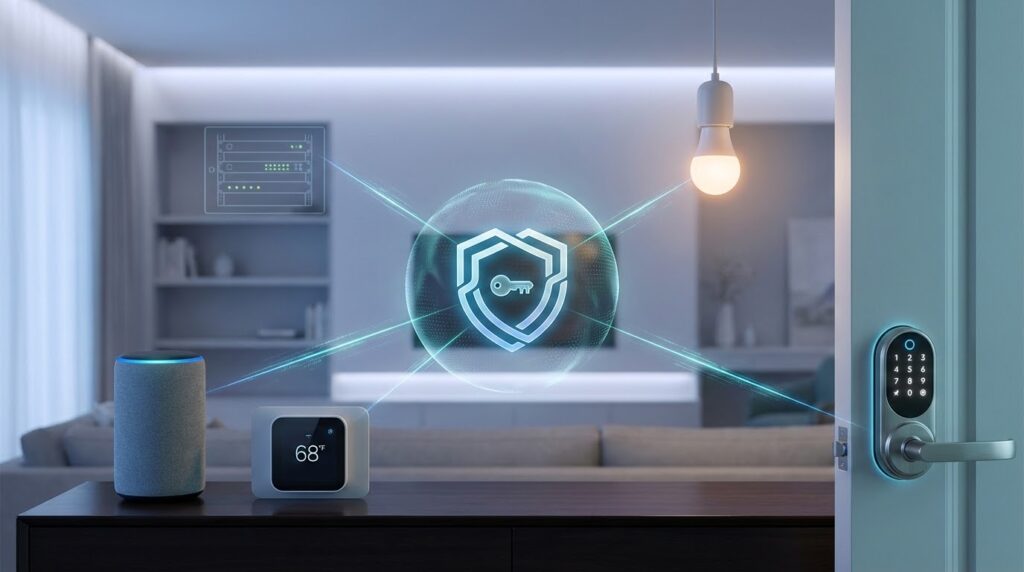
Welcome to the world of smarter, safer connected homes. The smart home ecosystem is growing rapidly, bringing new devices into our lives every day. This growth creates exciting possibilities but also introduces important safety considerations.
Traditional approaches often focused mainly on securing communication channels. The new framework takes a different path. It ensures every piece of equipment must prove its identity before joining your network. This means no anonymous devices can enter your home system.
Major industry players collaborated to create these robust standards. They wanted to protect users while maintaining compatibility across different brands. You can learn more about the fundamental security principles that guide this approach.
Proof of ownership becomes your first line of defense. Each certified product undergoes rigorous verification processes. This gives manufacturers and consumers confidence in the legitimacy of their connected devices.
Key Takeaways
- Every device must prove its identity before joining a network
- Proof of ownership is the foundational security principle
- Industry collaboration ensures robust, interoperable standards
- The approach represents a significant advancement over traditional methods
- Certification processes verify device authenticity and legitimacy
- Users gain confidence in the safety of their connected home ecosystem
- The framework addresses modern smart home vulnerability concerns
Introduction to the Matter Security Framework
Today’s interconnected living spaces demand robust systems that ensure seamless operation while maintaining user trust. The rapid growth of connected technologies has transformed how we interact with our environments.
Overview of Smart Home and IoT Security
Modern households now contain numerous connected gadgets. These smart home devices range from thermostats to lighting systems. Each device adds convenience but also introduces potential vulnerabilities.
Traditional protection methods often focused on individual products. They lacked universal standards across different manufacturers. This created compatibility issues and inconsistent safety measures.
The Connectivity Standards Alliance recognized these challenges. They brought together industry leaders to develop a unified approach. This collaboration aims to establish reliable standards for all connected home devices.
Purpose and Goals of the Whitepaper
This document serves as a comprehensive guide to understanding modern protection frameworks. It explains the technical foundations in accessible language. Both manufacturers and consumers will find valuable insights here.
The whitepaper demystifies complex technical concepts. It provides practical guidance for implementing robust systems. Readers will learn about attestation processes and communication protocols.
| Approach Type | Key Features | Primary Limitations |
|---|---|---|
| Traditional Methods | Brand-specific solutions, Basic encryption | Limited interoperability, Variable protection levels |
| Modern Framework | Universal standards, Device attestation | Implementation complexity, Required certification |
| Proprietary Systems | Custom protocols, Manufacturer control | Vendor lock-in, Limited third-party integration |
The emergence of standardized protocols addresses critical industry needs. It establishes consistent practices that scale across millions of homes worldwide. This represents a significant advancement in connected home technology.
An Overview of the Matter Security Model
The foundation of a trustworthy smart home begins with verifying every component’s identity. This approach represents a significant shift from traditional methods that focused mainly on communication channels.
Proof of ownership becomes the first critical checkpoint. Each new gadget requires a unique passcode before joining your network. This ensures only authorized users can add equipment to their home system.
The attestation framework creates an unbreakable chain of trust. Manufacturers verify each device’s identity through the Connectivity Standards Alliance certification process. This guarantees authenticity from production to your living room.
Layered credential systems provide additional protection. Operational credentials are issued only after manufacturer verification succeeds. Network access follows successful certificate authentication.
| Security Approach | Identity Verification | Network Access |
|---|---|---|
| Traditional Methods | Optional or basic | Immediate after connection |
| Matter Protocol | Mandatory attestation | After credential verification |
| Proprietary Systems | Varies by manufacturer | Dependent on brand rules |
Transparency through open standards actually strengthens defenses. Security researchers can continuously audit and improve the protocol. This collaborative approach benefits everyone in the ecosystem.
These principles work together to protect devices throughout their lifecycle. From manufacturing to daily operation in your home, each layer adds crucial protection. The result is a comprehensive strategy that keeps your smart home secure.
Device Attestation and Certificate Authentication
Imagine each connected device carrying an unforgeable digital ID card that proves its legitimacy from factory to your home. This system ensures only properly certified gadgets can join your network. The process relies on specialized certificates that create a chain of trust.
Understanding the Device Attestation Certificate (DAC)
Every certified smart home product contains a unique device attestation certificate programmed during manufacturing. This DAC serves as the device’s permanent digital identity. It cannot be altered or copied once installed.
The certificate chain starts with the Product Attestation Authority as the root trust source. Manufacturers hold intermediate certificates that sign individual device certificates. This creates an unbreakable verification path.
The Certification Declaration and Its Role
The Certification Declaration is a cryptographically signed document from the Connectivity Standards Alliance. It contains vital vendor and product information. This declaration binds everything together for independent verification.
During commissioning, your system checks both the DAC and Certification Declaration. This dual verification prevents counterfeit devices from accessing your network. Only properly certified products pass this rigorous check.
| Certificate Type | Primary Purpose | Issuing Authority |
|---|---|---|
| Product Attestation Authority (PAA) | Root trust source for entire ecosystem | Connectivity Standards Alliance |
| Product Attestation Intermediate (PAI) | Signs individual device certificates | Device manufacturers |
| Device Attestation Certificate (DAC) | Unique identity for each device | Manufacturer (using PAI) |
| Certification Declaration (CD) | Verifies compliance and vendor details | Connectivity Standards Alliance |
“The certificate chain establishes trust that flows from recognized authorities down to individual devices in your home.”
This comprehensive approach gives consumers confidence in their smart home investments. It represents a significant advancement in connected home protection.
Establishing Secure Communications in Matter
The way connected gadgets talk to each other evolves as they move from setup to daily operation, using distinct encryption methods. This thoughtful approach ensures appropriate protection at every stage of a device’s lifecycle within your smart home ecosystem.
Comparison of PASE and CASE Processes
During initial setup, the Password Authenticated Session Establishment (PASE) process creates a safe environment. It uses the passcode from your device’s QR code to establish a protected channel.
The system employs the SPAKE2+ protocol for mutual verification. Both the controller and new equipment confirm passcode possession without transmitting the actual code over the network.
Once commissioning completes, Certificate Authenticated Session Establishment (CASE) takes over. This method uses operational certificates to validate that both devices belong to the same Matter protocol network.
In CASE sessions, peers exchange certificate information and negotiate symmetric encryption keys. These keys then protect all control commands and data transfers during normal operation.
This dual-process design provides robust protection tailored to each phase. Whether adding new equipment or maintaining daily communications, your network remains properly safeguarded.
Public Key Infrastructure and Certificate Chains
The technology that keeps your online banking safe also protects your smart home. This system is called Public Key Infrastructure, or PKI. It’s a proven method for creating digital trust.
PKI uses special digital files called certificates. These files act like unforgeable IDs for your device. They create a verifiable chain of trust from a top authority down to each individual gadget.
How PKI Secures Device Authentication
Think of the certificate chain as a family tree for your device’s identity. The root is the Product Attestation Authority (PAA). This is the ultimate source of trust for the entire ecosystem.
Manufacturers hold intermediate certificates (PAI). They use these to sign the unique Device Attestation Certificate (DAC) on every product. This process ensures each device is legitimate before it reaches you.
When you add a new smart plug or light bulb, your system checks this entire chain. It verifies the DAC links back to a trusted PAA. This mathematical proof prevents counterfeit devices from joining your network.
The Role of Certificate Authorities
Certificate Authorities (CAs) are the trusted entities that manage this system. They follow strict rules set by the Matter PKI Policy Authority. This governance maintains the system’s integrity.
These authorities issue and manage the certificates. They also handle revocation if a device or manufacturer’s status changes. This adds a crucial layer of ongoing security.
The beauty of this Public Key Infrastructure approach is its distributed nature. Your system can verify a device instantly without needing to call a central server every time.
| Certificate Level | Primary Function | Trust Relationship |
|---|---|---|
| Product Attestation Authority (PAA) | Serves as the root trust source | Trusted by all commissioners |
| Product Attestation Intermediate (PAI) | Signs individual device certificates | Trusted via the PAA |
| Device Attestation Certificate (DAC) | Unique identity for a single device | Trusted via the PAI and PAA chain |
“A robust Public Key Infrastructure allows every device to cryptographically prove its authenticity, creating a foundation of trust that scales to millions of homes.”
This hierarchical structure is a core strength. It provides a familiar, standard method for experts while offering powerful protection for users. The attestation process becomes a seamless, behind-the-scenes guardian of your home network.
The Commissioning Process and Onboarding Protocols
When you unbox a new smart home gadget, a sophisticated onboarding procedure springs into action. This carefully designed process ensures your new equipment integrates safely into your existing setup.
Steps Involved in Device Discovery and Secure Channel Establishment
The commissioning journey follows four essential steps. First, device discovery occurs where your new gadget announces its availability. Your controller app locates it using unique identifiers.
Next, a secure channel forms using Password Authenticated Session Establishment (PASE). This creates a protected tunnel for sensitive information exchange. The system verifies possession of the correct passcode without transmitting it openly.
Device attestation then validates the gadget’s authenticity through certificate checks. Finally, configuration completes the setup by assigning operational credentials.
Commissioning Flow and Payload Formats
The onboarding payload contains all necessary setup information. It comes in human-readable numeric strings or machine-readable QR codes. This flexibility accommodates different user preferences.
Payload contents include version details, vendor and product IDs, and discovery capabilities. The passcode establishes proof of ownership during the process. Different commissioning flows suit various scenarios from automatic to user-initiated setups.
This structured approach transforms isolated devices into trusted network members. Each step builds upon the previous one, creating a seamless yet protected onboarding experience.
Security Tenets and Compliance with Connectivity Standards Alliance
Building a truly protected smart home ecosystem requires more than just individual device safeguards—it demands a comprehensive framework of principles and enforceable rules. The Connectivity Standards Alliance has established foundational tenets that guide every certified product’s development.
Design Principles and Mandated Security Requirements
The alliance’s approach ensures protection isn’t an afterthought but woven into the protocol’s architecture. Manufacturers face strict “SHALL” requirements that are absolutely mandatory for compliance.
During manufacturing, each device receives a unique DAC certificate and Certification Declaration. This prevents cutting corners on essential safeguards. The framework covers everything from initial setup to ongoing operations.
Commissioning processes must verify device authenticity against the Distributed Compliance Ledger. All communications require strong encryption, protecting your commands from interception. This creates a consistent baseline across the industry.
The standards also mandate over-the-air update capabilities. This recognizes that protection evolves, and vulnerabilities need patching after deployment. For those starting their smart home journey, understanding these principles is crucial when setting up your first smart home.
These requirements distinguish mandatory elements from recommended best practices. The Connectivity Standards Alliance continuously refines these standards as new threats emerge.
Physical Security Considerations in Smart Home Devices
While most protection focuses on network communications, physical access to devices introduces unique vulnerabilities that require specialized hardware solutions. Manufacturers must address threats that occur when attackers can directly handle equipment.
Mitigating Physical and Tampering Attacks
Physical attacks target the actual hardware components of smart home devices. These include tampering attempts and side-channel analysis. Attackers measure power consumption to infer secret information.
Debug interfaces present another risk. These tools help developers but can become entry points if not properly secured. The specifications recommend restricting access through fusing techniques.
Protecting private keys from extraction is crucial. These cryptographic keys represent the digital identity of each device. Compromised keys could enable cloning or impersonation attacks.
Manufacturer Approaches to Hardware Security
Companies implement various hardware security measures to meet these challenges. Trusted Execution Environments provide secure storage for sensitive data. More advanced solutions use Physical Unclonable Functions.
Solutions like Silicon Labs’ Secure Vault offer comprehensive protection. They feature true random number generators and side-channel resistant cryptographic engines. Anti-tamper mechanisms detect physical interference attempts.
Manufacturers balance cost against protection levels based on device value and target markets. Higher-value equipment typically receives more robust hardware safeguards.
Insights from Industry Research and Real-World Findings
Independent security research provides critical real-world testing for any new technology standard. Nozomi Networks Labs recently examined commercial Matter devices to understand how the protocol’s protections perform against sophisticated attacks.
Nozomi Networks Labs Research Overview
Their investigation revealed both impressive design strengths and implementation challenges. Researchers discovered that while debug interfaces were properly locked, underlying hardware vulnerabilities allowed fault injection attacks.
This technique bypassed hardware protections and enabled memory extraction. Through reverse engineering, they compromised a custom obfuscation procedure protecting the device attestation private key.
Implications of Vulnerabilities for the IoT Ecosystem
These findings highlight a significant concern for the smart home ecosystem. Compromised device attestation keys could enable cloning of popular home devices.
The Connectivity Standards Alliance emphasizes that protections must evolve over time. This is especially important given the extended lifespans of smart home devices.
| Protection Level | Implementation Status | Research Findings |
|---|---|---|
| Debug Interface Locking | Properly implemented | Bypassed via hardware vulnerability |
| Private Key Obfuscation | Custom vendor solution | Successfully reversed by researchers |
| Certificate Revocation | Matter 1.2 feature | Requires manufacturer adoption time |
Fortunately, the ecosystem includes mitigation strategies. Access Control Lists can limit what actions compromised devices perform. The certificate revocation mechanism provides a path to disable compromised credentials.
These research findings help manufacturers strengthen their product implementations. They also inform consumers about the evolving nature of connected home protections.
Conclusion
Looking across the entire landscape of connected home technology, the emphasis on device verification marks a significant advancement in protection strategies. This approach ensures every component proves its legitimacy before joining your network.
The ecosystem approach brings together manufacturers, standards bodies, and consumers in a shared commitment to safety. Continuous software updates and evolving connectivity standards will strengthen these protections over time.
For homeowners, this means greater confidence in smart home devices. For manufacturers, it represents an opportunity to build trust through compliant products. The future of connected living depends on this collaborative effort.