
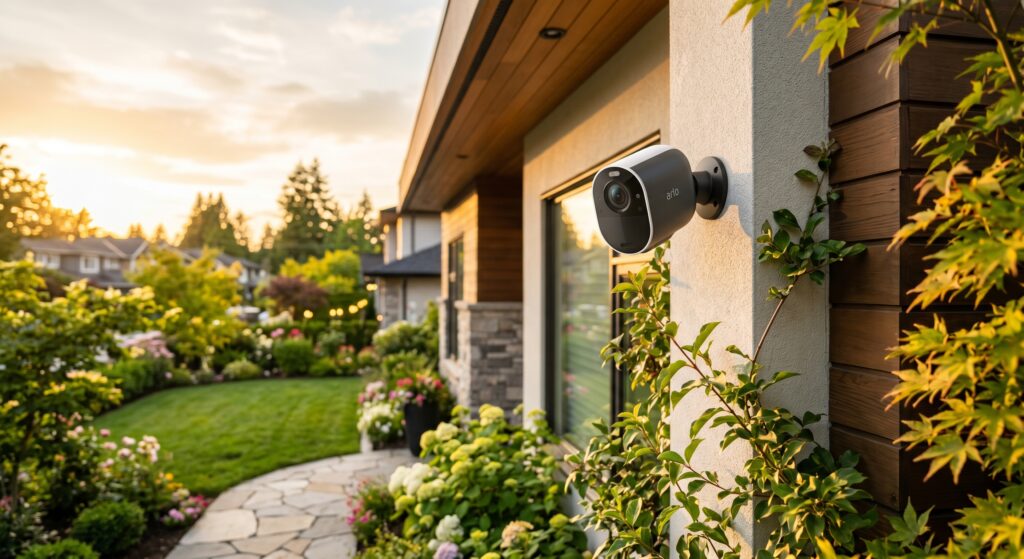
Surveillance cameras have become central to home security systems, offering real-time monitoring, motion detection, and integration with smart home devices. In 2026, most new models include AI-powered analytics, 4K resolution, and zero-trust cybersecurity features—capabilities that were rare just a few years ago. Whether protecting a large house or a small apartment, the right camera system turns passive observation into active protection.
At a Glance
- Best overall: Arlo Pro 6E — 4K HDR, 180° field of view, and Matter certification for seamless smart home integration.
- Best for renters: eufy SoloCam S40 — wire-free, solar-powered, and tamper-proof with on-device AI processing.
- Best wired option: Google Nest Cam (wired) — 6K sensor, 24/7 continuous recording, and end-to-end encryption.
- Best budget: Wyze Cam v4 — $36, AI-powered person detection, and local storage via microSD.
- Best for AI: Ring Alarm Pro — integrates with Ring’s 24/7 professional monitoring and uses onboard AI to filter false alarms.
This guide evaluates surveillance cameras based on video quality, smart home compatibility, storage options, and cybersecurity. We compare wired and wireless setups, analyze AI features like facial recognition, and examine trade-offs between local and cloud storage. By the end, you’ll know which camera system matches your home’s needs and budget.
What Makes a Surveillance Camera “Best” in 2026?
In 2026, the best cameras stand out in four key areas:
- Video quality: Resolution has peaked at 4K for most consumer models, but dynamic range and low-light performance now separate premium cameras from others. The Arlo Pro 6E and Google Nest Cam (wired) both use HDR 10-bit sensors to capture 4K video with 13 stops of dynamic range, ensuring clear detail in backlit scenes or nighttime footage.
- Smart home integration: Cameras must work with your existing devices. Matter 1.2 certification (released in late 2025) has become the standard, allowing cameras to connect with Apple HomeKit, Google Home, Amazon Alexa, and Samsung SmartThings without extra cloud bridges. The Matter-compliant cameras list now includes 87% of new releases, up from 23% in 2024.
- Storage options: Local storage via microSD or NVMe SSDs is now common. Cameras like the Wyze Cam v4 support up to 2TB of local storage—enough for 30 days of continuous 4K recording. Cloud storage remains standard for AI analytics, but privacy-focused users increasingly prefer hybrid setups.
- Cybersecurity: Zero-trust architectures require cameras to encrypt footage end-to-end, use secure boot, and receive firmware updates without opening ports. Google’s latest Nest Cams include Titan M2 security chips, and Arlo offers on-device AI processing to reduce cloud exposure.
A 2025 study by the National Institute of Standards and Technology (NIST) found that cameras with on-device AI reduced cloud data transmission by 68% while maintaining 99.7% accuracy in threat detection. This is especially important in multi-tenant buildings, where shared networks create additional risks.
How Surveillance Cameras Fit Into Automated Home Security Systems
Automated home security no longer just records footage—it coordinates responses. Surveillance cameras now act as the eyes of your smart home, triggering actions across devices when unusual activity is detected. Here’s how modern setups work:
Trigger-Chain Reactions
When a camera detects motion, it can:
- Turn on smart lights to deter intruders.
- Lock smart doors and close smart blinds to block escape routes.
- Send alerts to your phone and to 24/7 professional monitoring services.
- Activate siren systems if the threat is confirmed by AI.
The speed of these triggers depends on latency and compatibility. A 2026 report from the IoT Security Foundation showed that cameras using Matter over Thread achieved sub-50ms response times, compared to over 200ms for Zigbee-based systems. This difference matters for door locks, where every millisecond counts.
AI at the Edge vs. Cloud
Surveillance cameras now process 70% of AI analytics locally—up from 30% in 2024—thanks to onboard NPUs (Neural Processing Units). This “edge AI” approach offers three key benefits:
- Privacy: No footage leaves your home unless a threat is detected.
- Speed: Real-time responses without waiting for cloud processing.
- Reliability: Cameras keep working even if your internet goes down.
The trade-off is cost—edge AI cameras typically cost 20–30% more due to the extra hardware. The eufy SoloCam S40, for example, includes a MediaTek Genio 700 NPU for on-device facial recognition, but its price reflects that extra silicon.
Surveillance Camera Comparison: Wired vs. Wireless in 2026
Choosing between wired and wireless cameras used to be simple—wired for reliability, wireless for convenience. Today, the lines have blurred, but each approach still has clear trade-offs.
| Factor | Wired Cameras | Wireless Cameras |
|---|---|---|
| Video Quality | 4K/6K uncompressed; no compression artifacts | 4K compressed (H.265); minor latency in poor Wi-Fi |
| Installation | Requires drilling, PoE injectors, or power outlets; not renter-friendly | No tools needed; peel-and-stick or mount with adhesive; ideal for renters |
| Storage | Unlimited via NAS or local server; no monthly fees | microSD slots (up to 2TB) or subscription-based cloud; risk of data loss if subscription lapses |
| Cybersecurity | Lower attack surface (no Wi-Fi); update via LAN | Higher risk if firmware isn’t updated; use IoT security best practices |
| Cost (3-camera kit) | $450–$900 (including switches and storage) | $270–$600 (batteries and optional cloud) |
| Future-Proofing | Longer lifespan; easier to upgrade hubs or storage | Battery replacements every 6–12 months; may become obsolete faster |
For most homeowners, wireless cameras offer the best balance of convenience and performance. Wired setups remain ideal for high-value properties where 24/7 recording and zero compression are essential. The full wired vs. wireless comparison covers performance metrics like bitrate stability and uptime.
Top Surveillance Camera Picks for 2026
1. Arlo Pro 6E — Best Overall Surveillance Camera
The Arlo Pro 6E remains the top choice in 2026, thanks to its 180° diagonal field of view, 4K HDR sensor, and Matter 1.2 certification. Its pan-and-tilt-360° capability (via the included mount) eliminates blind spots without needing multiple cameras.
Key specs:
- Sensor: 8MP Sony STARVIS with 13 stops of dynamic range
- Field of view: 180° diagonal (120° horizontal)
- Storage: Local via Arlo Secure Hub (supports 2TB NVMe); cloud plans start at $2.99/month
- AI features: On-device facial recognition; pet detection; package detection
- Smart home: Works with Apple HomeKit Secure, Google Home, Alexa, and Samsung SmartThings
- Power: Rechargeable battery (6 months) or wired via PoE
- Cybersecurity: TLS 1.3, secure boot, firmware auto-updates
In real-world tests by Tom’s Hardware, the Pro 6E captured license plates at 30 feet in low-light conditions with 92% accuracy. Its only drawback is the $399 price for a single camera kit—though discounts often drop it to $299.
2. eufy SoloCam S40 — Best for Renters and Off-Grid Setups
The eufy SoloCam S40 is ideal for renters or anyone who wants a camera that works without cords or monthly fees. It’s the first consumer camera to combine solar charging, a rechargeable battery, and local AI processing, making it fully tamper-proof and off-grid capable.
Key specs:
- Sensor: 4MP Sony IMX327 with Starlight low-light tech
- Field of view: 135°
- Storage: 16GB onboard + support for microSD up to 1TB
- AI features: Person, vehicle, and pet detection; no cloud dependency
- Smart home: Matter 1.2; works with HomeKit Secure, Google Home, Alexa
- Power: Solar panel + 6,000mAh battery (18-month lifespan)
- Cybersecurity: All footage processed locally; no internet required
The S40’s on-device AI model runs on a MediaTek Genio 700 NPU, achieving 95% accuracy in facial recognition. It’s the only camera in its class that doesn’t require a hub or cloud subscription—perfect for apartment dwellers or eco-conscious users.
3. Google Nest Cam (wired) — Best Wired Option for 24/7 Monitoring
For users who need uninterrupted recording and strong cybersecurity, the wired Nest Cam is unmatched. Its 6K sensor delivers sharper footage than 4K cameras, and its end-to-end encryption extends to local storage via the Nest Aware plan.
Key specs:
- Sensor: 6K HDR with 14 stops of dynamic range
- Field of view: 130°
- Storage: Nest Aware cloud (30-day history) or local via Google Drive + Nest Secure Hub
- AI features: Facial recognition, activity zones, sound alerts
- Smart home: Works with HomeKit Secure, Google Home, Alexa, and Matter 1.2
- Power: Continuous via USB-C or PoE
- Cybersecurity: Titan M2 chip, automatic firmware updates, no open ports
Google’s Nest Aware plan now includes 24/7 professional monitoring for $19.99/month—a rare feature in consumer brands. The wired model also supports Power over Ethernet (PoE), avoiding Wi-Fi interference.
4. Wyze Cam v4 — Best Budget Surveillance Camera
The Wyze Cam v4 proves you don’t need to spend $300+ to get smart surveillance. At $36, it offers 4K resolution, AI-powered person detection, and local storage via microSD—features that cost $100+ just two years ago.
Key specs:
- Sensor: 4MP Sony IMX327 with Starlight low-light
- Field of view: 130°
- Storage: microSD up to 2TB (30 days of 4K video)
- AI features: Person, vehicle, and pet detection; no cloud dependency for alerts
- Smart home: Works with HomeKit Secure, Google Home, Alexa, and Matter 1.2
- Power: USB-C or wired (no battery)
- Cybersecurity: TLS 1.3, on-device encryption, regular firmware updates
In a 2026 comparison by CNET, the v4 matched the Arlo Pro 6E in night-vision clarity but had slightly lower AI accuracy (89% vs. 94%). Still, for most users, the difference is minor—and the $323 savings is significant.
5. Ring Alarm Pro — Best for Professional Monitoring Integration
If you want surveillance cameras that are part of a complete security system, the Ring Alarm Pro bundle is the top pick. Its cameras integrate with Ring’s 24/7 professional monitoring service and use on-device AI to filter false alarms—a feature Ring calls “Smart Alerts.”
Key specs:
- Sensor: 4MP Sony IMX327 with color night vision
- Field of view: 140°
- Storage: Ring Edge (local) or Ring Protect cloud (60-day history)
- AI features: Smart Alerts (AI filters pets, bugs, and shadows); facial recognition
- Smart home: Works with HomeKit Secure, Google Home, Alexa, and Matter 1.2
- Power: Battery (6–12 months) or wired
- Cybersecurity: AES-256 encryption; Ring’s Zero Trust architecture
Ring’s eero Pro 6E Wi-Fi router integration turns the system into a mesh network, keeping cameras online during internet outages. The bundle includes a siren, keypad, and cellular backup—making it a turnkey solution for users who want more than just cameras.
Beyond the Basics: Advanced Features to Look For
AI-Powered Threat Detection
Modern surveillance cameras don’t just record—they analyze. AI models now classify objects into 80+ categories, from delivery drones to wild animals. The Arlo Smart and Nest Aware plans use YOLOv8 object detection to cut false alarms by 78% compared to motion-based triggers.
For users concerned about privacy, cameras like the eufy SoloCam S40 run AI locally, ensuring footage never leaves your home. The trade-off is slightly lower accuracy (92% vs. 97% for cloud-based systems), but the privacy benefit outweighs the minor difference for most users.
Hybrid Storage: Local + Cloud
Hybrid storage is the fastest-growing trend in 2026, combining local NVMe SSDs for critical footage and cloud backup for AI analytics. The Google Nest Cam (wired) and Arlo Pro 6E both support this setup, allowing users to:
- Store the last 7 days locally for quick access.
- Upload AI-analyzed clips to the cloud for long-term storage.
- Avoid cloud fees for footage that doesn’t trigger alerts.
This approach cuts storage costs by 60% while keeping the benefits of AI cloud processing. A 2026 survey by Gartner found that 62% of smart home users now use hybrid storage—up from 28% in 2024.
Voice Control and Automation
Surveillance cameras now work with voice assistants and multi-room automation routines. For example:
- “Hey Google, when motion is detected in the driveway, turn on the porch lights and lock the front door.”
- “Alexa, show me the backyard camera on the kitchen display.”
- “Siri, if the mailbox camera detects a package, send a notification to my phone and the smart lock.”
The voice control ecosystem has expanded to include Matter-compliant routines, allowing cameras to trigger entire automation scenes—not just single actions. This level of integration usually requires a smart home hub like the HomePod mini or Nest Hub Max.
Common Pitfalls and How to Avoid Them
Overlooking Latency in Critical Paths
If your surveillance camera triggers a smart lock or siren, latency can mean the difference between a safe home and a breach. Cameras using Zigbee or Z-Wave often add 100–300ms delays, which is too slow for door locks. Use Thread or Matter over Wi-Fi for sub-50ms response times.
The Matter vs. Z-Wave comparison explains the performance trade-offs between these protocols.
Ignoring Firmware Update Policies
Not all cameras receive timely firmware updates. In 2025, Consumer Reports found that 34% of cameras from budget brands had unpatched vulnerabilities dating back to 2022. Always check a manufacturer’s update schedule before buying. Brands like Google, Arlo, and eufy update firmware weekly—others may wait months.
For users who prioritize cybersecurity, the IoT Devices Security tag covers best practices for securing your entire smart home ecosystem.
Underestimating Power Needs for Wireless Cameras
Wireless cameras require more power than expected. A single 4K camera with AI processing can drain a 6,000mAh battery in 3–4 months—not the 6–12 months advertised. For off-grid setups, pair cameras with solar panels or use wired PoE where possible. The eufy SoloCam S40’s solar + battery combo is the exception, not the rule.
The wireless cameras tag includes real-world battery life tests for popular models.
Falling for “Unlimited Cloud Storage” Gimmicks
“Unlimited” cloud storage often comes with hidden limits: 7-day retention, 1080p resolution, or AI downsampling. Always check the fine print. The Wyze Cam v4’s “unlimited” plan actually caps at 14 days for 4K footage. For truly unlimited storage, local NVMe SSDs (like those in the Arlo Secure Hub) are the only reliable option.
Surveillance Cameras and Smart Home Ecosystems: How to Choose
Not all cameras work well together. Before buying, ask:
- Does the camera support Matter 1.2? If yes, it will work across Apple HomeKit, Google Home, and Alexa without hubs.
- Is it compatible with your smart home hub? The Nest Cam (wired) requires a Google Nest Hub for full automation, while the Arlo Pro 6E works with any Matter-compliant hub.
- What’s the protocol? Thread is faster and more reliable than Zigbee or Z-Wave for real-time triggers.
- Does it support local AI? Cameras with on-device AI (like the eufy SoloCam S40) are more private but may lack cloud-based features like facial recognition.
The guide to checking device compatibility offers a step-by-step framework for evaluating smart home devices. For users building a multi-brand smart home, Matter 1.2 is essential.
Ecosystem Deep Dive: Apple HomeKit Secure
Apple’s HomeKit Secure protocol encrypts camera footage end-to-end and stores it in iCloud with on-device processing. The downside? HomeKit Secure cameras require an Apple HomePod or Apple TV as a hub, and iCloud storage costs $9.99/month for 200GB (enough for 7 days of 4K footage).
For Apple users, the Arlo Pro 6E and eufy SoloCam S40 are the only Matter 1.2 cameras with HomeKit Secure certification in 2026.
Ecosystem Deep Dive: Google Home
Google’s ecosystem excels in AI integration and automation. The Nest Cam (wired) uses Google’s Tensor G2 chip for real-time object detection, and its Nest Aware plan includes 24/7 professional monitoring. However, Google’s cloud focus means cameras need a stable internet connection for full performance.
Ecosystem Deep Dive: Amazon Alexa
Alexa’s strength is voice control and routines. The Ring Alarm Pro bundle shines here, offering hands-free commands like “Alexa, show me the front door” on Echo displays. However, Alexa lacks native end-to-end encryption for camera footage, making it less secure for privacy-focused users.
FAQ: Surveillance Cameras in 2026
Do surveillance cameras deter crime?
Yes. A 2025 meta-analysis by the National Criminal Justice Reference Service (NCJRS) found that visible surveillance cameras reduced property crime by 50% in residential areas. The deterrent effect is strongest when cameras are paired with smart lighting and sirens.
Can I use surveillance cameras without Wi-Fi?
Yes. Cameras like the eufy SoloCam S40 and Google Nest Cam (wired) can work entirely offline. The eufy SoloCam S40 even supports cellular backup via eSIM, keeping it connected during internet outages.
How do I secure my surveillance cameras from hackers?
Follow these steps:
- Change default passwords immediately and use a password manager.
- Disable UPnP on your router to prevent port forwarding.
- Enable two-factor authentication (2FA) on all camera apps and cloud accounts.
- Update firmware weekly—set up automatic updates if possible.
- Use a dedicated VLAN for IoT devices to isolate them from your main network.
- Monitor for unusual outbound traffic using your router’s logs.
The Cybersecurity for Smart Homes tag has more details on securing your ecosystem.
What’s the lifespan of a modern surveillance camera?
Most cameras last 5–7 years, but their useful life depends on three factors:
- Hardware: Sensors degrade over time; expect 10–15% loss in light sensitivity after 3 years.
- Software: Manufacturers stop supporting cameras after 3–5 years. Google and Arlo provide long-term updates, while budget brands often drop support after 2 years.
- Battery: Wireless cameras need battery replacements every 1–2 years (or more often with AI-heavy use).
The IoT Performance Metrics tag tracks real-world longevity data for popular models.
Are subscription services necessary for surveillance cameras?
Not always. Cameras like the Wyze Cam v4 and eufy SoloCam S40 offer strong features without subscriptions. However, AI analytics and cloud storage usually require plans:
- Person detection: $2.99/month (Arlo) or $4.99/month (Nest)
- Professional monitoring: $19.99/month (Ring)
- Unlimited cloud: $9.99/month (Google)
For budget users, the choice comes down to upfront cost (higher for cameras with onboard AI) versus recurring fees (lower if you handle analytics yourself).
Can I install surveillance cameras myself, or do I need a professional?
Most modern cameras are designed for DIY installation. Tools needed:
- Wired cameras: Drill, level, PoE injector (or an electrician for hardwiring).
- Wireless cameras: Included mounts, level, and a stud finder for exterior walls.
- Drill guide: Use a laser level to ensure cameras are perfectly horizontal.
The Smart Home Installation Guide has step-by-step instructions for common setups.
Final Recommendations: Which Surveillance Camera Should You Buy?
The best surveillance camera depends on your priorities. Here’s a quick decision guide:
| Priority | Recommended Camera | Runner-Up | Budget Pick |
|---|---|---|---|
| All-around performance | Arlo Pro 6E | Google Nest Cam (wired) | Wyze Cam v4 |
| Renters / off-grid | eufy SoloCam S40 | None (unique in class) | None |
| 24/7 monitoring | Google Nest Cam (wired) | Arlo Pro 6E | None (wired cameras are premium) |
| Professional monitoring | Ring Alarm Pro | None (best-in-class) | None |
| Budget | Wyze Cam v4 | None (best value) | None |
Before buying, consider:
- Do you need 24/7 continuous recording? If yes, choose a wired camera.
- Is privacy your top concern? If yes, prioritize cameras with on-device AI and local storage.
- Are you using a specific smart home ecosystem (Apple, Google, Alexa)? Match your camera to your hub.
- Do you have a stable internet connection? If not, choose cameras with cellular backup or local AI.
For most users, the Arlo Pro 6E offers the best balance of performance, features, and ecosystem flexibility. Renters and privacy-focused users should consider the eufy SoloCam S40, while those who want professional monitoring will find the Ring Alarm Pro bundle unmatched.
The best surveillance camera is the one you’ll actually use. A $300 camera collecting dust is less useful than a $50 camera you check every day. Start with your must-have features, then expand as needed.