
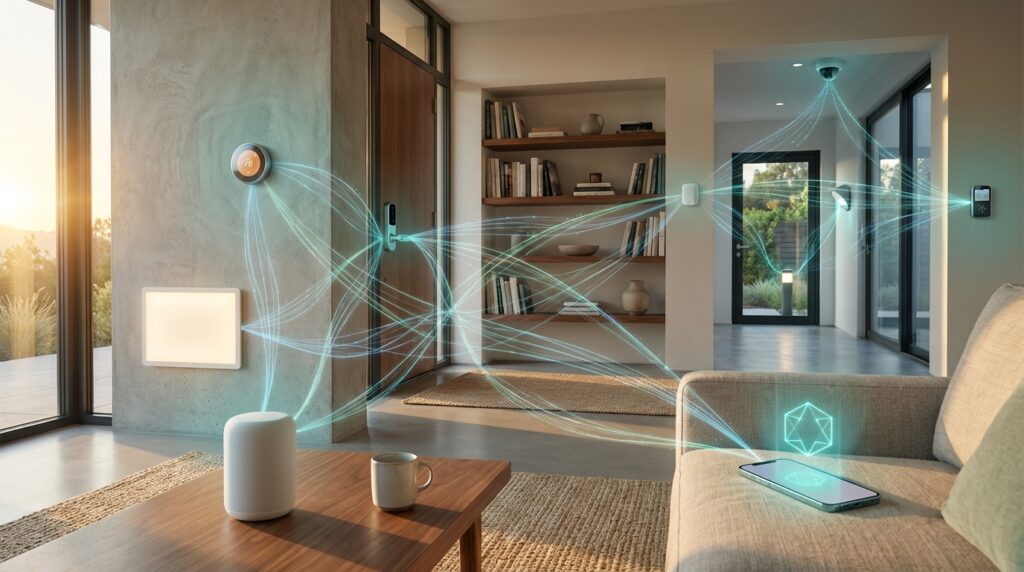
Welcome to the exciting world of connected living! Building a smart home should be simple and rewarding. Understanding how different technologies work together is key to creating a seamless experience.
The combination of Matter and Thread represents a powerful advancement in home automation. This pairing transforms how your gadgets communicate with each other. It delivers significant improvements in performance compared to older systems.
This guide breaks down complex technical concepts into friendly explanations. We’ll help you make informed decisions about your connected ecosystem. You’ll learn how to create a more responsive and reliable setup.
While terms like Zigbee and Wi-Fi can seem overwhelming, we’ll show how they fit together. By the end, you’ll clearly understand what makes this technology special. You’ll know if it’s the right choice for your specific needs.
Key Takeaways
- Matter and Thread work together to create a more unified smart home experience
- This combination offers faster response times for voice commands and automations
- Connections become more reliable with fewer unexpected dropouts
- The technology extends range to reach outdoor devices like smart locks
- It represents the industry’s solution to years of fragmentation and incompatibility
- Understanding these technologies helps you build a better connected home
- The system compares favorably against alternatives like Zigbee and traditional Wi-Fi
Understanding the Fundamentals of Matter and Thread
At the heart of a seamless smart home experience lie two key technologies working in harmony. Think of them as the grammar and the postal service for your gadgets. One defines the rules of conversation, while the other ensures the messages are delivered quickly and reliably.
Defining Matter as a Universal Smart Home Standard
The first piece of this puzzle is the new universal standard. Developed by the Connectivity Standards Alliance, it acts as a common language. This allows different products to understand each other, no matter who makes them.
This approach is a big shift from older, closed systems. It is an open-source and secure technology. This means you get more choices and better compatibility across brands.
It’s important to know that this standard isn’t a wireless protocol itself. Instead, it works on top of existing ones like Wi-Fi and the mesh networking protocol. This unifies different communication methods under one framework. The key benefits include universal compatibility with major platforms and simplified setup. You can learn more about what this standard means for your smart home.
Exploring Thread: The Mesh Networking Protocol for Smart Devices
The second technology is the mesh networking protocol designed specifically for connected homes. Created by a group of industry leaders, it operates exclusively on IPv6. This provides native internet connectivity to your gadgets.
This protocol creates a resilient, self-healing network. Each device can relay messages to others, eliminating single points of failure. If one device goes offline, the network automatically finds a new path.
Technical advantages include low latency for real-time commands and dynamic routing. This keeps your network running smoothly. While the standard defines *what* devices say, this protocol defines *how* they connect. They work together beautifully to create a powerful combination.
Speed, Reliability, and Range: Breaking Down the Differences
Performance in connected homes isn’t just about fast internet—it’s about instant responses, stable connections, and comprehensive coverage. These three pillars work together to create a seamless smart home experience.
Analyzing Latency and Response Times in Smart Networks
Speed in home automation means low latency. This is the delay between your command and the device’s action. Unlike download speeds, latency affects how quickly lights turn on or sensors trigger.
The right protocol delivers near-instant responses. Voice commands execute without hesitation. Security alerts activate immediately. This creates a responsive environment where technology feels natural.
“The difference between a good smart home and a great one comes down to milliseconds. When devices respond instantly, you stop thinking about the technology and start enjoying the convenience.”
Evaluating Network Coverage and Signal Strength
Reliability means consistent performance without dropouts. A robust network maintains connections even when individual devices encounter issues. This prevents frustrating moments when commands fail.
Mesh architecture extends your coverage significantly. Each device acts as a signal repeater. Commands hop from one unit to another, reaching distant areas like backyards or garages.
| Network Type | Latency Performance | Coverage Range | Reliability Score |
|---|---|---|---|
| Traditional Wi-Fi | Medium | Limited | Fair |
| Hub-Based Systems | Low | Dependent on Hub | Poor |
| Mesh Networks | Very Low | Whole Property | Excellent |
Key advantages include self-healing capabilities and dynamic routing. If one path fails, data automatically finds another route. This ensures your smart devices remain accessible throughout your home.
Exploring “matter over thread” in Smart Home Connectivity
Today’s connected homes benefit from an industry-wide collaboration that solves long-standing compatibility challenges. This powerful combination represents a significant leap forward in how gadgets interact within your living space.
How Matter Enhances Interoperability Across Devices
The universal standard ensures different brands work together seamlessly. Products from various manufacturers can now understand each other perfectly.
This eliminates the frustration of checking compatibility lists before purchases. When you see the certification badge, you know it will integrate with your existing ecosystem.
The Role of Thread in Establishing a Resilient Network
The mesh networking protocol creates a self-healing foundation for your smart home. Each unit acts as a signal repeater, extending coverage throughout your property.
This architecture ensures reliable communication even when individual components encounter issues. The network automatically finds alternative paths to maintain connections.
| Feature | Interoperability Benefits | Network Resilience Advantages |
|---|---|---|
| Universal Language | Works across all major platforms | Standardized communication protocols |
| Brand Compatibility | No separate bridges required | Consistent performance standards |
| Single App Control | Unified management interface | Centralized network monitoring |
| Family Sharing | Multiple user platform support | Distributed access points |
Key advantages include simplified setup processes and robust performance. This approach future-proofs your investment while delivering immediate convenience.
Comparative Analysis: Zigbee, Thread, and Matter
The architectural differences between Zigbee, Thread, and Matter reveal why each protocol serves distinct purposes in home automation. Understanding these distinctions helps you choose the right technology for your specific needs.
System Architectures and OSI Layer Considerations
Zigbee operates as a complete protocol stack, handling everything from physical transmission to application data. It uses a centralized coordinator to manage its mesh network. This creates a self-contained system for device communication.
Thread focuses specifically on efficient network routing at the OSI model’s network layer. It employs IPv6 for native internet connectivity. The protocol creates a distributed, self-healing mesh where any device can route data.
Matter functions as an application-level standard that sits above networking protocols. It defines how devices communicate regardless of the underlying network. This fundamental difference enables cross-protocol compatibility.
Security, Scalability, and Industry Adoption
Both Zigbee and Thread offer robust security implementations. Zigbee uses AES-128 encryption within its alliance framework. Thread includes built-in secure commissioning for device authentication.
Scalability shows another key difference. Thread’s distributed architecture strengthens as you add more devices. Zigbee’s centralized coordinator can face limitations in large installations.
Industry adoption patterns vary significantly. Zigbee has widespread support with thousands of products from various manufacturers. Thread and Matter represent newer standards with rapidly growing support from the Connectivity Standards Alliance. For a detailed comparison of these technologies, explore our comprehensive guide to smart home protocols.
Each technology excels in different applications. Zigbee remains strong in commercial lighting systems. Thread delivers excellent performance for residential applications requiring low latency. Matter provides the universal layer that spans multiple underlying protocols.
Implementing Smart Home Technologies: Benefits and Considerations
Modern smart home implementation focuses on creating systems that grow with your needs. The right foundation makes all the difference in daily use. Choosing compatible products ensures your investment serves you well for years.
Many Google devices function as both controllers and Thread border routers. These include Nest Hub and Nest WiFi Pro models. They connect your smart devices to home internet while maintaining local communication.
Integration with Platforms like Google Home
Setup becomes incredibly simple with Fast Pair technology. Android devices detect new smart home gadgets automatically. The Google Home app walks you through configuration without app switching.
Voice commands work naturally through Google Assistant. Control smart lighting, door locks, and sensors with simple phrases. Family members can use different assistants like Alexa or Siri for the same devices.
Future-Proofing Your Home with Over-the-Air Updates
Many manufacturers update existing products through software improvements. Consumers don’t need to replace current devices for new features. This protects your investment as technology evolves.
Consider your home’s layout when planning coverage. Larger spaces may need additional border routers for complete mesh networks. Start with essential applications like security sensors or climate control.
Key benefits include multi-platform flexibility and seamless upgrades. Your smart home adapts to changing needs without compatibility concerns. The system grows with your family’s lifestyle.
Conclusion
Creating a truly interconnected home environment is becoming simpler with industry-wide cooperation. The combination of Matter and Thread represents a significant leap forward for smart home technology. This partnership solves long-standing compatibility issues while delivering superior performance.
Understanding these technologies empowers you to build a responsive, reliable smart home with confidence. You’ll enjoy faster responses, stronger connections, and wider coverage throughout your living space. Different brands now work together seamlessly under one universal standard.
Look for the Matter certification when choosing new devices. Check if your current hub supports Thread functionality. Gradually transition toward this future-proof approach as you expand your connected home. The smart home future promises greater choice and better interoperability for everyone.